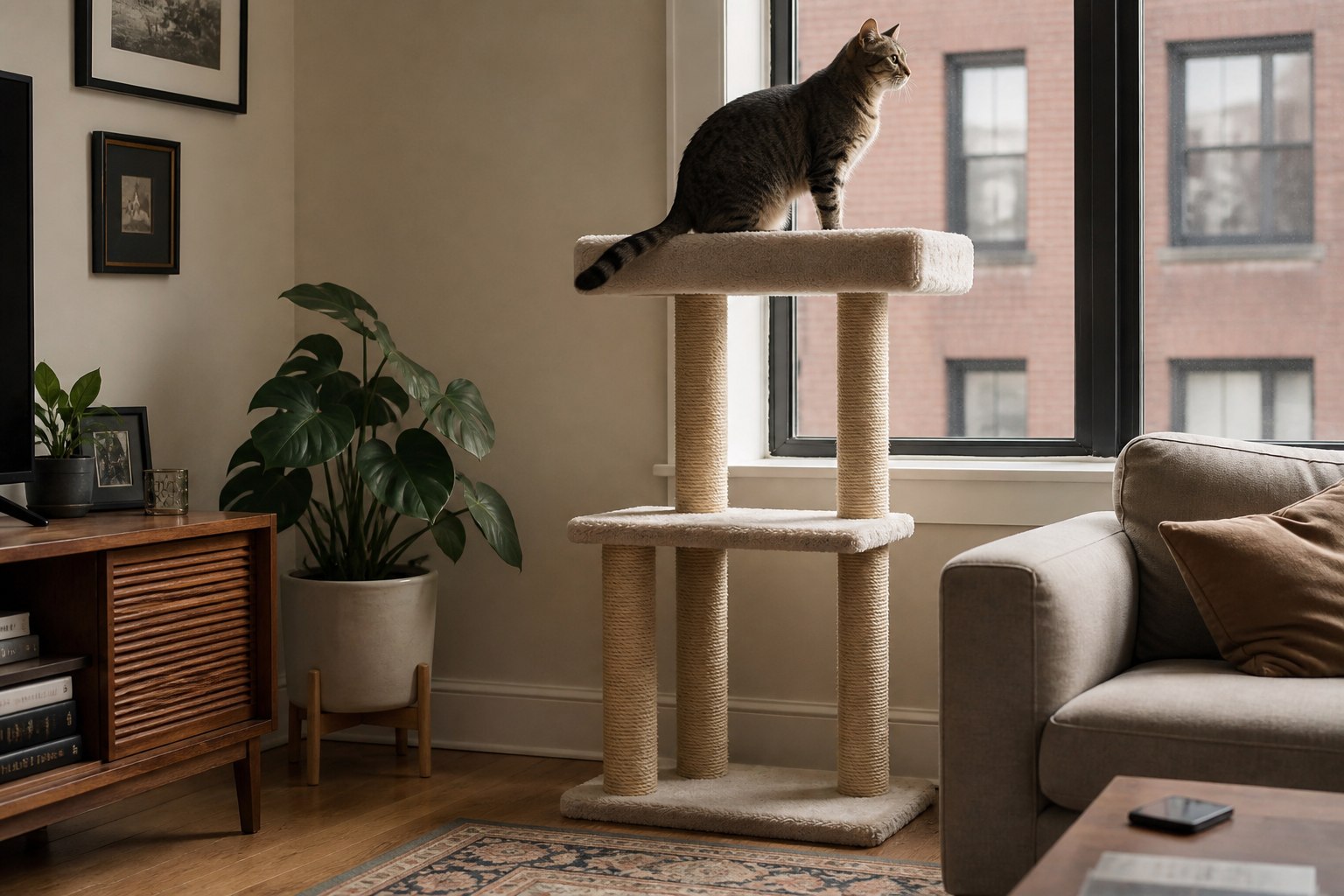

A cat tree can look substantial online and still fail in the room where it has to live. The base overlaps a cabinet door. The top bed presses into the curtain. A long-bodied cat can sit on the platform but cannot settle there. The only workable corner is so far from the window and the rest of the household that the tree gives the cat little reason to climb it.
Start with the room and the cat rather than the number of levels in a product photo. A good choice has a clear job, a useful address, a route the cat can manage, and a base that stays steady on the floor where it will stand. It also has to remain livable after the new-furniture novelty is gone.
Give the Tree One Job
Name the missing function before comparing products. Perhaps the cat needs a window perch, a place to rest above floor traffic, a vertical scratching surface, an easier climb to an existing shelf, or a retreat in a social room. “More enrichment” is too vague to tell you whether a particular tree will help.
Then look at what already works. A broad windowsill may provide the view. A sturdy cabinet with a safe approach may provide the elevated bed. A separate scratcher may fit the cat’s posture better than the short wrapped sections on a multi-level tree. If the room already has stable destinations and usable routes, the right purchase may be no tree at all. The same restraint applies to other everyday cat essentials.
If the real gap is a route through the room, begin with the vertical-space plan. N10 starts one step later: deciding whether a freestanding tree is the right piece of that plan.
Put It in the Room Before You Buy It
Choose the address before the silhouette. A modest tree beside a window the cat already watches can be more useful than a taller one in a quiet corner nobody visits. In a large living room, distance from household activity may matter more than available floor area. In a narrow room, one overhanging bed can turn a comfortable walkway into something people brush past all day.
Mark the base on the floor with painter’s tape or pieces of paper. Add the outline of any platform, hammock, or bed that projects beyond it. Product photos often make the top look like the footprint, but those two shapes may be quite different.
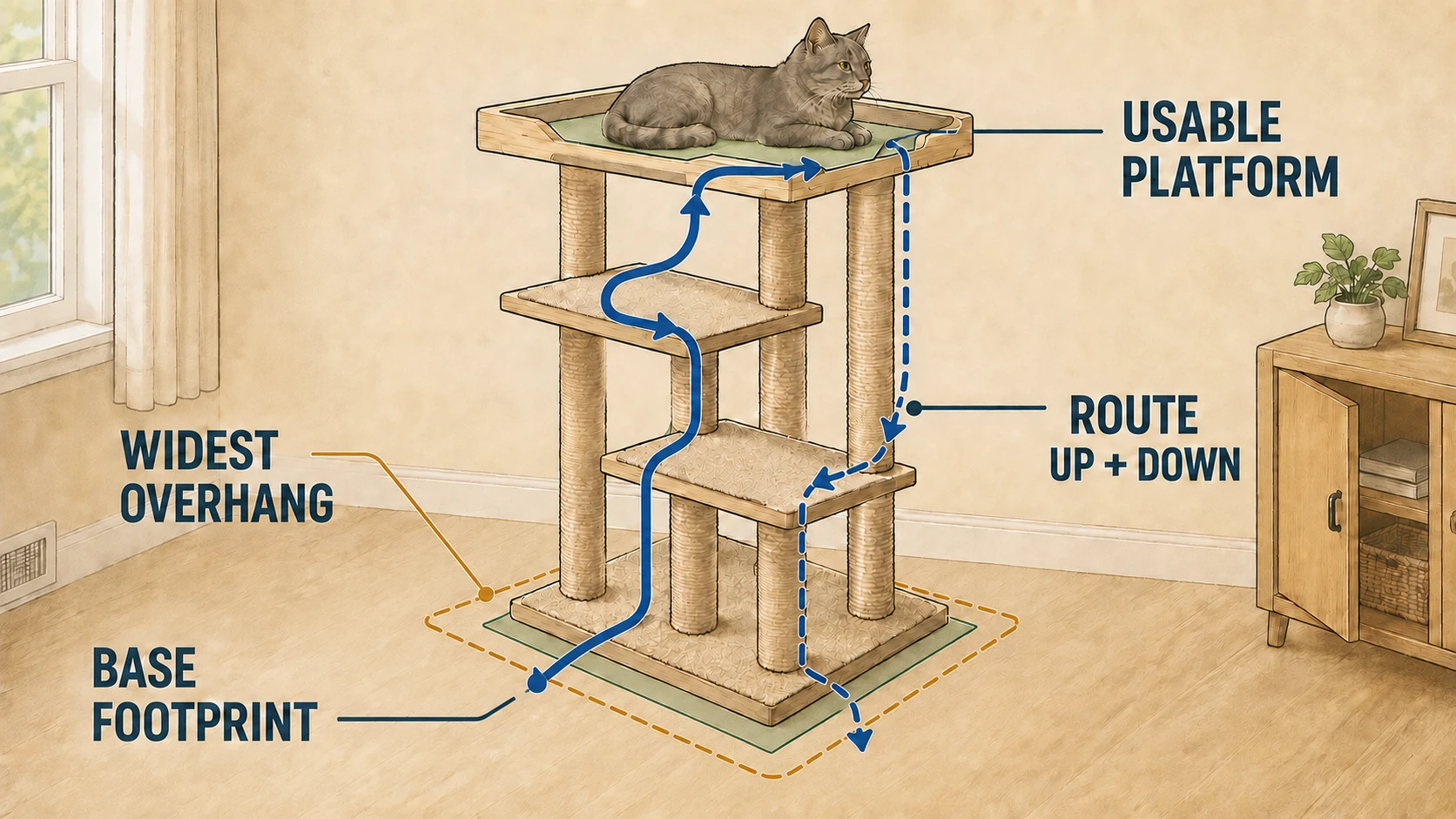
Walk around the outline with the room in use. Open the nearby door, drawer, and cabinet. Pull the curtain. Check the vent, radiator, and window hardware. Carry a laundry basket or vacuum through the normal route, then make sure you can still reach the base and the hair-catching corners.
A corner can keep the structure out of traffic while leaving the cat with one approach and an awkward way down. Beside a sofa, a lower level may gain an easy step while the upper bed sits in people’s reach. Near a window, the view adds a reason to climb, while direct sun, a blind cord, or a narrow sill changes the setup.
In a small apartment, look for useful height without disabled storage, blocked circulation, or a daily furniture-moving job. The small-space catification guide covers the wider room balance.
Let the Cat Narrow the Feature List
Watch the cat before deciding which platforms, beds, cubbies, and scratching surfaces deserve space. A cat that stretches out on a table needs a different resting surface from one that curls tightly inside boxes. A cat that reaches high and pulls down needs an uninterrupted vertical scratching area; a short wrapped post broken by a shelf may look functional and still interrupt the movement.
Measure the flat area the cat can actually occupy. Posts, raised rims, and openings can take a large bite out of the listed platform dimensions. The AAFP/ISFM environmental-needs guidelines recommend perches and shelves that allow a cat to stretch fully. They do not supply one shopping measurement for every cat. Compare the open surface with the animal who will turn, lie down, and get up on it.
For a large or heavier cat, platform space and structural steadiness both deserve attention. A weight rating does not show how much room the cat has to turn or how the tree behaves during a sideways jump. A bed that looks generous for a kitten may become the smallest usable surface later.
Older cats and cats with limited mobility often benefit from lower stages and traction on the approach. International Cat Care’s home-modification guidance discusses steps, ramps, and non-slip access. A sudden reluctance to jump, new stiffness, or a changed gait belongs with a veterinarian.
Treat scratching and hiding as separate decisions. An observational owner survey on scratching behavior found associations between scratcher form and use, but it did not establish one ideal material or shape for every cat. Start with the surface and posture this cat already chooses. If furniture is the current target, the scratching-redirection guide handles that behavior in depth.
Judge the Tree as an Installed Structure
Stability belongs to the assembled tree on the actual floor. Height, base width, and a weight claim on the listing cannot settle the question by themselves. A broad base can rock across the edge of a thick rug. A compact structure can feel steady when its joints are sound, the base sits flat, and the cat does not have to launch sideways from a large overhang.
Before purchase, look for clear assembly instructions and a manufacturer-approved way to secure the tree if anchoring is required. After assembly, press at the levels where the cat will climb, scratch, turn, and jump away. Rocking, sliding, twisting at a joint, or lifting at one base edge needs to be resolved before use. Recheck hardware as the manufacturer directs; do not improvise a wall attachment the structure was not designed to accept.
Trace the full trip from floor to top and back down. Each stage needs enough landing space to support the next movement. A high platform loses value when a bed rim blocks the approach, a post occupies the landing, or the descent requires one large blind jump. This is a product-level check, while N07 retains the broader room route.
In a multi-cat home, one narrow ladder to one prized platform may become a blockable route. The 2024 AAFP intercat-tension guidelines emphasize distributed, visually separated access to important resources. That principle does not create a one-tree-per-cat formula. It asks whether this tree is being treated as the only elevated refuge. The multi-cat resource-layout guide covers the whole-home problem.
Make the Trade-Offs on Purpose
A long feature list hides the fact that every tree spends space somewhere. Compare the gains and costs that matter in the intended room:
- More height or better placement: Extra levels add little when the tree must live far from the view or route the cat values.
- A broader base or clearer floor space: A wide stance may help a design resist movement while consuming a walkway or blocking a cabinet. Judge the assembled structure.
- A large bed, a cubby, or an open level: Each uses space differently. Choose the surface the cat is likely to occupy, including enough room to turn and settle.
- Integrated scratching or an uninterrupted stretch: Wrapped posts save a separate object only when their exposed length and surface match the cat’s behavior.
- Soft upholstery or easier maintenance: Plush fabric can be comfortable; fixed covers and tight seams hold hair and complicate spills.
Appearance belongs in the decision without becoming a style ranking. Color cannot rescue an awkward route or undersized bed, but a structure the household dislikes may end up in the least useful corner.
Account for the other bodies in the room. A dog may crowd the base, a toddler may pull a low hammock, and an overhanging platform may sit at shoulder height beside a chair. If ordinary movement makes the setup unsafe or irritating, change the product or the address.
Take One Last Walk Around It
Before ordering, finish these five sentences without relying on “the cat will probably adjust”:
- This tree’s job is ___, and the room does not already provide it well.
- It will stand ___, because that address gives the cat a reason to use it.
- This cat can approach, climb, turn, rest, and come down on the available surfaces.
- The installed base can sit flat and remain steady on that floor, using only approved assembly or anchoring methods.
- The household can open doors, move through the room, clean the tree, and keep it in that useful spot.
If one answer depends on hiding the tree in a spare corner, accepting a wobble, or hoping a small platform will be “close enough,” pause the purchase. Retape the floor, compare a different structure, or solve the missing function another way.