
A home can contain a bed, a scratcher, toys, and all the expected bowls yet still be awkward for a cat to use. The bed may sit where people constantly pass. The scratcher may be hidden in a quiet room while the sofa marks the route everyone shares. A narrow hallway may turn into a bottleneck when another pet lies across it.
The useful question is not, “What cat item belongs in this room?” It is, “What is the cat trying to do here—and can that happen without conflict?” Sometimes the answer is rest or watch. Sometimes it is simply pass through, leave an interaction, or reach water without crossing a busy feeding area.
A cat-friendly home is a network, not a collection of products. This checklist follows that network through an ordinary home, including homes where one room does several jobs and no space belongs to the cat alone.
Start With the Routes Between Rooms
Before assessing the sofa, bowls, or window perch, walk the routes that connect them. Do this when the home is active: doors are moving, someone is cooking, the dog is in the hall, or children are arriving. A route that looks clear in an empty room may feel very different at the busiest part of the day.
Look for narrow doorways, slippery landings, unstable stacks, and places where the cat must pass close to another animal. Notice dead ends. If a cat reaches a resting spot but has to come back through one easily blocked entrance, the spot may offer less choice than it appears to.
Professional feline environmental guidance identifies safe places and multiple, separated resources—food, water, toileting, scratching, play, and rest—as foundations of a supportive environment. It does not mean duplicating every resource in every room. In a real home, the principle is more useful as a route check: can the cat reach what it needs, and is there another option when one path becomes busy?
This whole-home view is what separates a systematic home audit from a list of comfort upgrades. If you want a shorter starting point, these simple ways to make an indoor cat more comfortable cover the individual basics. Here, the job is to see how those choices work together.
Entryways and Hallways: Make Transitions Deliberate
An entry is a human transition zone—shoes, bags, deliveries, greetings—but for a cat it can also be a sudden opening to the outside. Keep the immediate door swing and landing clear enough that you can see where the cat is before opening the door. A second barrier, such as an interior door, can be useful in some layouts, but the everyday habit matters more than an elaborate “airlock” that the household will not use consistently.
Hallways deserve attention because they concentrate traffic. Move unstable piles and objects that force a cat into the middle of foot traffic. If the floor is slick, a washable runner may create a more secure path, provided it stays flat and does not become another tripping point.
Do not try to solve door-dashing behavior inside this checklist. The setup job is narrower: preserve visibility, reduce surprise, and avoid making the only route to food, water, rest, or the litter area pass directly through the most chaotic arrival point.
The Living Room: Support Sharing Without Requiring It
The living room is often where the cat and household spend the most time. It should allow closeness without making interaction compulsory.
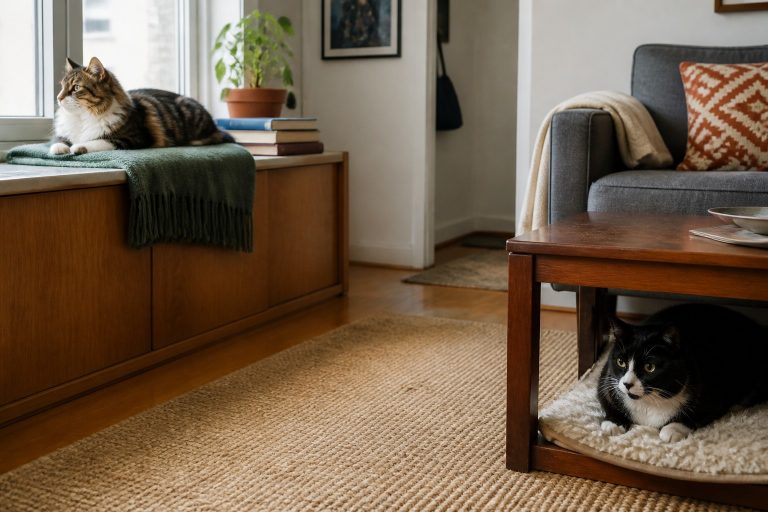
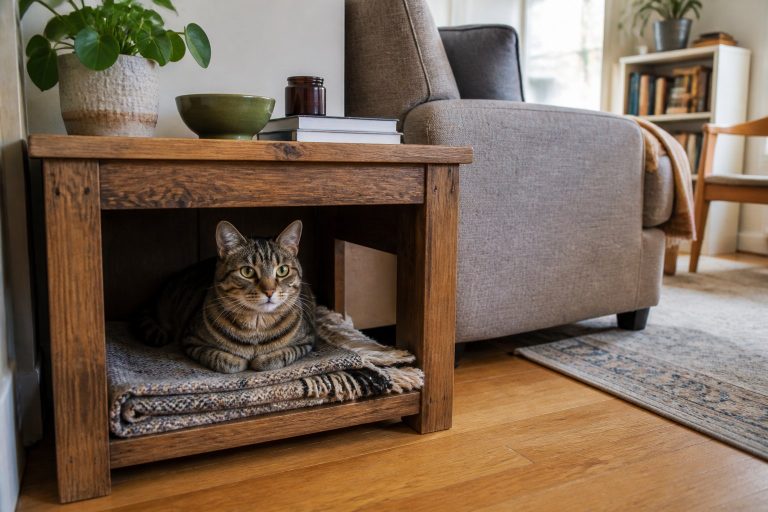
Start with rest. A chosen end of the sofa, a folded blanket on a chair, or a quiet surface near the room can be as useful as a dedicated bed. Add a retreat where the cat is less exposed to feet and guests—a box beside a cabinet, open space under a bench, or another spot the household agrees not to reach into. A safe place works because the cat can choose it, not because it matches a product description.
Then look at observation and movement. One stable elevated position can give the cat a view of the room and an alternative to the busy floor. This checklist does not prescribe shelves or explain how to choose a cat tree; it only asks whether the cat has a secure place to watch and a sensible way up and down. Detailed vertical-route planning deserves its own guide.
Scratching is more likely to be useful where the cat already stretches, wakes, or travels. Ohio State’s guidance on scratching notes the relevance of resting areas, entrances, and frequently used parts of the home. That supports placing an appropriate surface near the existing behavior rather than hiding it in a spare corner. If furniture is already being scratched, the guide to redirecting scratching without punishment takes that problem further.
Finally, check cables, unstable decor, and furniture that can tip if used as a landing. This is not a reason to empty the room. Secure the specific weak points on the routes your cat actually uses.
Kitchen and Dining: Separate Care From Food-Prep Conflict
The kitchen concentrates smells, heat, sharp tools, appliances, and human movement. It may also hold the cat’s feeding station because the floor is easy to clean. That can work if the cat can approach, eat, drink, and leave without standing in the main cooking path.
Watch one complete meal. Does a person repeatedly step over the cat? Does another pet wait in the doorway? Does a dishwasher or trash cabinet open into the feeding space? Moving bowls a few feet, rotating their orientation, or opening a second exit can sometimes improve the routine without creating a new feeding station.
Food, water, and toileting resources should not be compressed into one convenient household corner. Separation is a high-confidence welfare principle; the exact distance is not. Use the room and the cat’s behavior rather than inventing a universal measurement. The calm feeding-area guide covers bowls, traffic, cleanup, and multi-cat meals in more detail.
Keep food scraps, hot surfaces, strings, and breakable items out of the routes the cat uses. If counter access is the conflict, protect the immediate hazard and preserve a legal observation point nearby where practical. A full counter-behavior plan requires more than a room check; this article should not turn the whole kitchen into a training program.
The Bedroom: Choose a Rule the Household Can Keep
There is no universal answer to whether a cat should sleep in the bedroom. Some households share the room comfortably. Others sleep better with the door closed. The room-by-room question is whether access is predictable and whether the cat has another workable place to settle.
If the cat is welcome, check the path onto and off the bed, especially for a kitten, senior cat, or cat with limited mobility. A stable chair or low surface may already provide an easier step. Keep string, medications, and small chewable items out of reach, and make sure a favorite hiding spot cannot be accidentally shut inside a closet or drawer.
If the room is closed at night, do not make it the only place with the cat’s preferred bed, water, or quiet retreat. A closed door changes the usable home. The practical fix is not necessarily to reopen it; it may be to establish an equally dependable option outside before bedtime.
The bedroom does not need a duplicate of every resource. It needs a clear household decision, a comfortable alternative when access changes, and enough consistency that the cat is not negotiating a different rule every night.
Bathroom and Utility Areas: Check What Closes, Starts, or Spills
Small enclosed rooms can look quiet but change quickly. A bathroom door closes. A washer starts. Cleaning products move from a cabinet to the floor. The main job here is not enrichment; it is making sure the room cannot become an unnoticed trap or hazard.
Store cleaners and medications where the cat cannot access them. Cornell’s overview of common household hazards for cats supports treating household chemicals and human medications as real risks without turning this checklist into a toxin encyclopedia.
Keep washer and dryer doors closed when they are not in use, and check the drum before every cycle. International Cat Care’s home-safety guidance makes that direct recommendation. Check cupboards, linen closets, and folding doors before closing them as well.
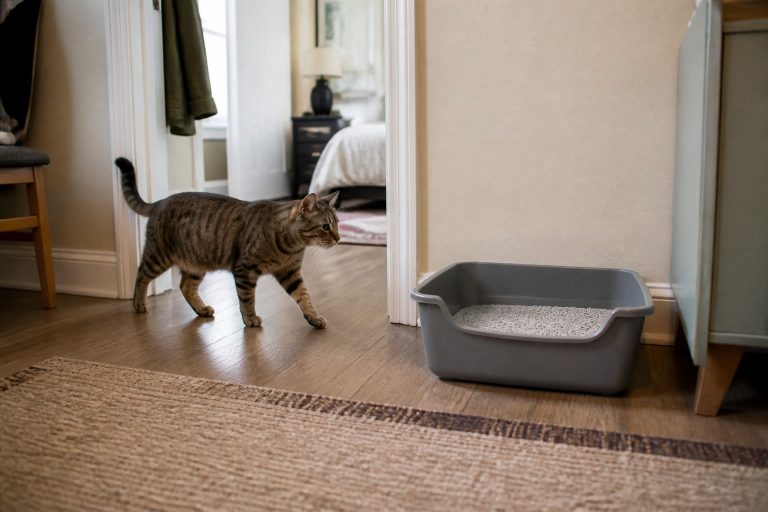
A litter box may live in a bathroom or utility area, but it is only one part of the room. Confirm that the door cannot block access, an appliance does not make the route unpredictable, and the household can clean the area without dismantling it. The full litter-area setup guide owns the box, litter, maintenance, and fit decisions.
Windows and Other Edges: Make the View Secure
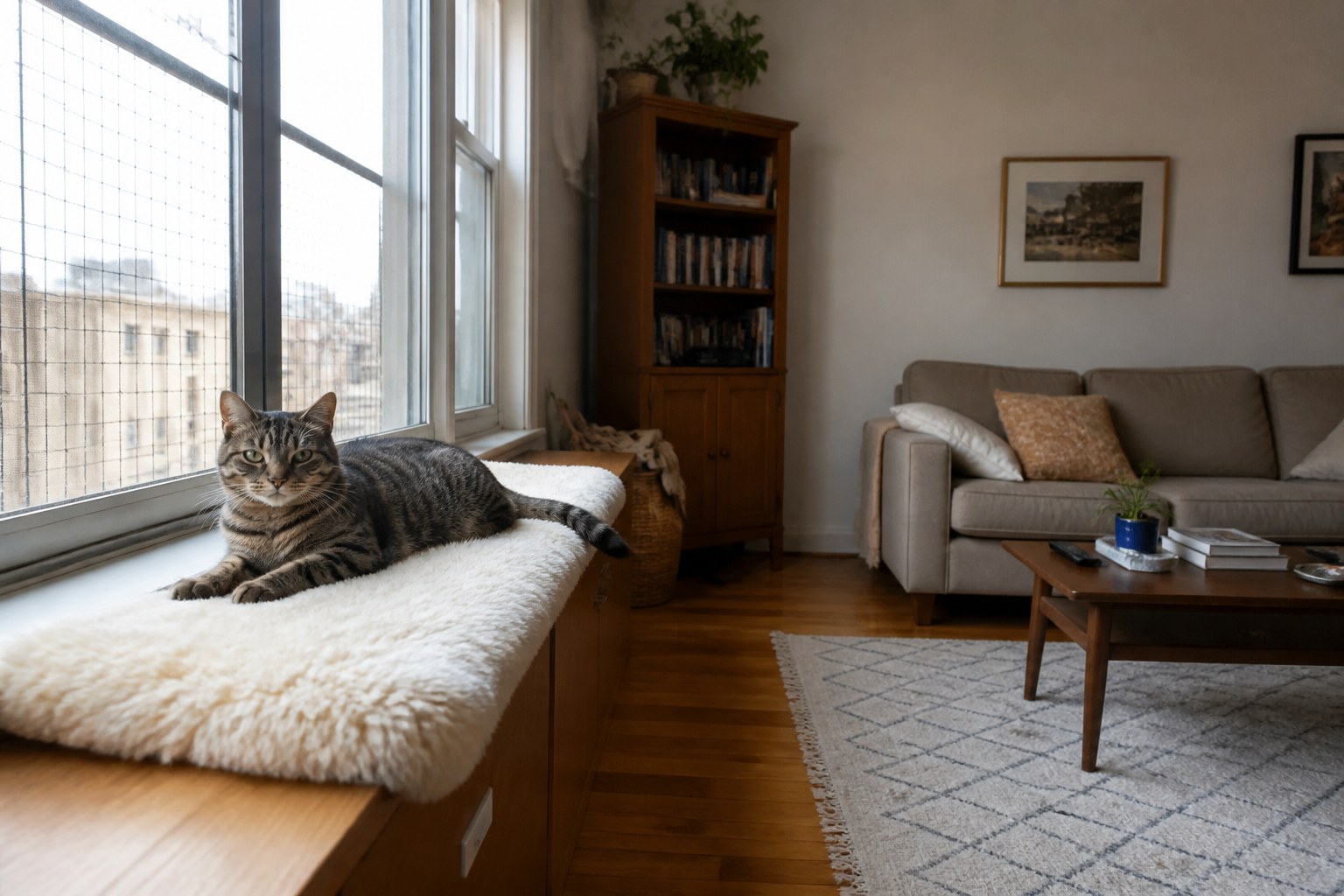
A window can support watching, resting, warmth, and distance from activity without adding another object to the floor. Start with the barrier. The ASPCA recommends snug, securely fitted window screens and warns that childproof window guards are not sufficient protection for cats.
Then inspect the landing. A sill, chair, or bench should be stable, wide enough for the cat using it, and reachable without a jump through fragile decor. Secure blind cords and do not assume a tilted or partly open window is safe simply because the gap looks narrow.
The best view is not always the brightest one. Notice heat, direct afternoon sun, drafts, and whether the cat can leave the spot easily. Vertical-space design and enrichment routines deserve their own deeper guides; here, the job is simply to confirm that the view is secure and usable.
Small and Multi-Use Homes: Layer Functions, Not Clutter
A studio does not need a feeding room, playroom, and cat room. One area can do more than one job when the functions do not conflict.
A storage bench may provide a window seat while keeping toys out of the walking path. A chair can serve as an intermediate step and remain useful to a person. A cardboard box can become a retreat without claiming permanent floor space. These are household design suggestions, not scientific requirements.
What matters is preserving enough separation for incompatible resources and enough open space to move. Do not place food beside the litter box because both fit under the same console. Do not turn the only route through the room into a row of beds and scratchers. The small-space catification guide offers more design ideas once the functional map is clear.
In a multi-cat home, count routes as well as resources. Current intercat-tension guidance emphasizes distributing safe places, food, water, litter boxes, and scratching surfaces through each cat’s usable environment. A resource can appear available yet be difficult to reach when another cat watches the doorway or controls the narrow path beside it. Obvious fighting is not the only sign that a layout lacks choice.
A Quick Whole-Home Check
Walk the home once more and ask:
- Can the cat reach key resources when normal doors are open or closed?
- Is there at least one place to rest without being approached or handled?
- Can the cat observe shared space without staying in the busiest floor path?
- Are scratching options placed where scratching or post-rest stretching already occurs?
- Can the cat enter and leave important areas without being cornered by a person or another pet?
- Are food, water, and toileting areas separated as much as the home reasonably allows?
- Are windows secured and unstable landing points corrected?
- Are cleaners, medications, cords, and utility machines managed where they create a real risk?
- Does the setup still leave clear floors, usable furniture, and routines the household can maintain?
Do not try to correct every weak point in one weekend. Choose the bottleneck that affects daily life most, make one workable change, and watch how the cat uses it. A home becomes more cat-friendly when its ordinary routes and choices improve—not when every room announces that a cat lives there.