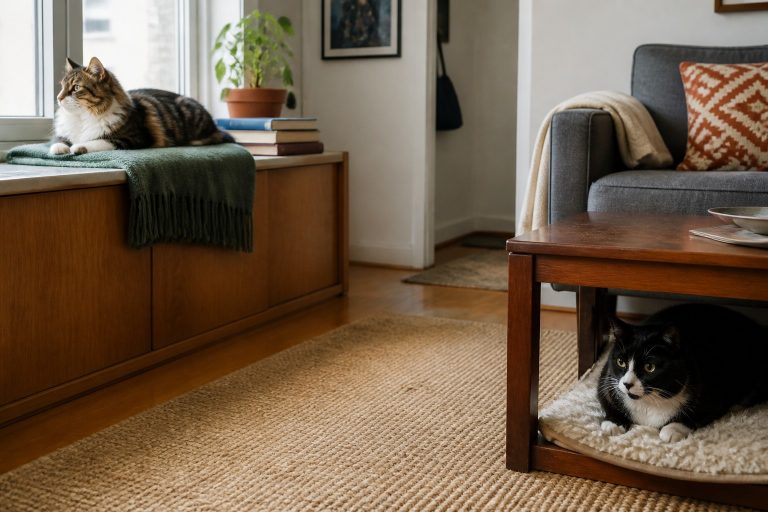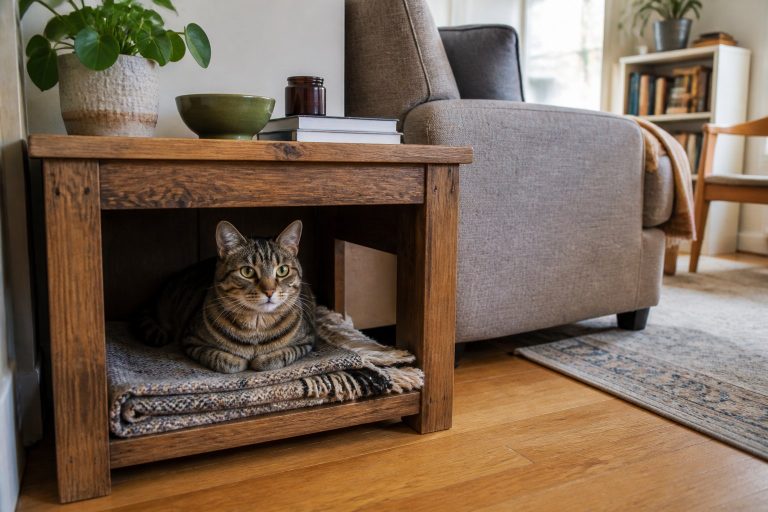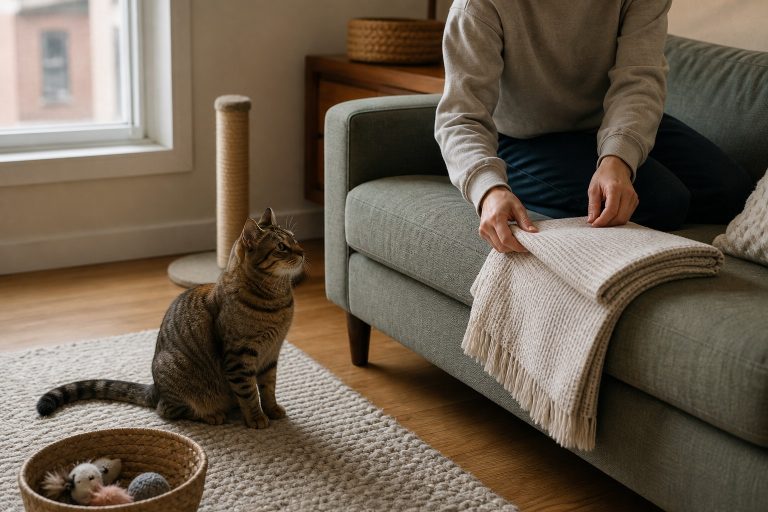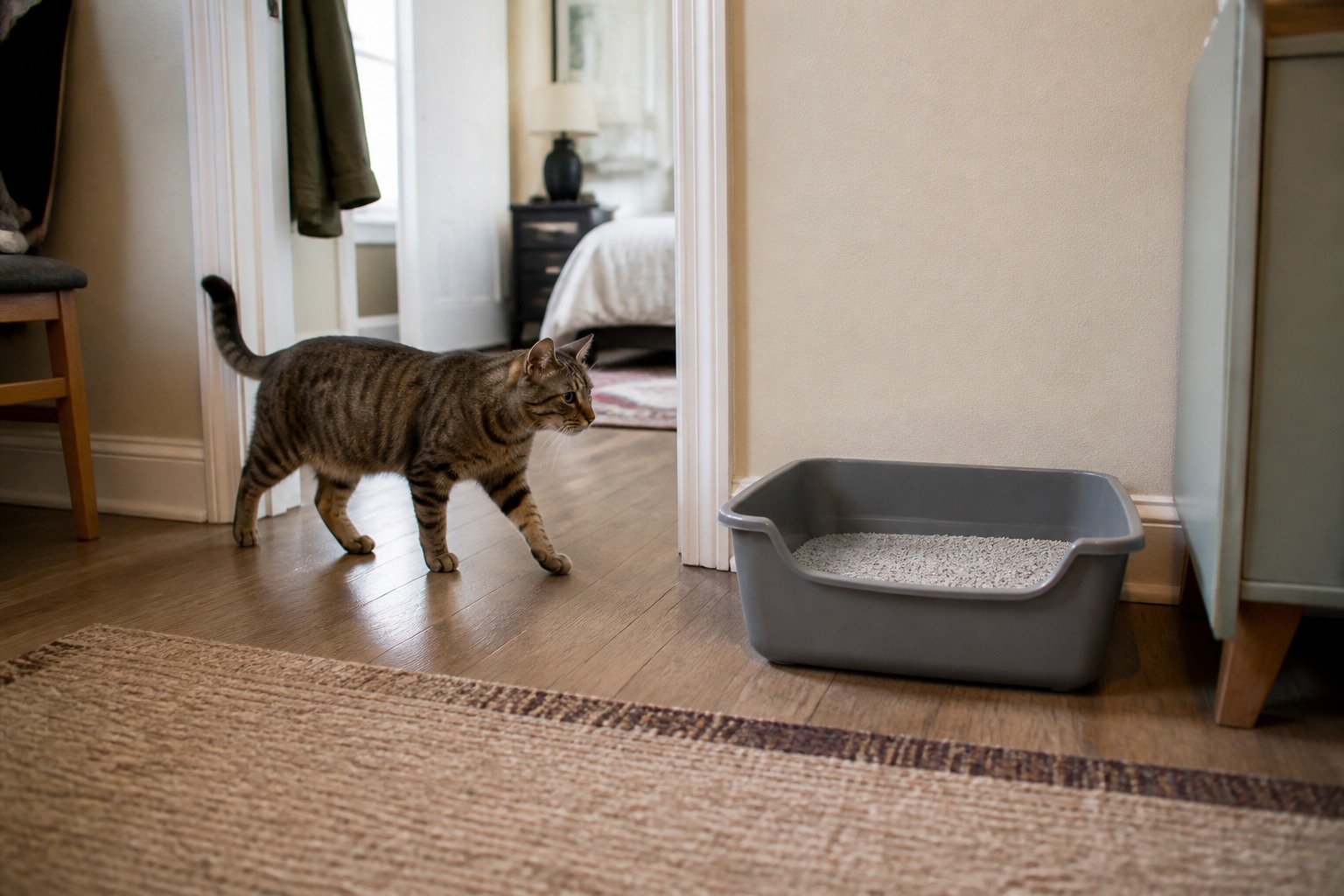

For two cats, the familiar calculation gives three litter boxes. The plan can still fail if a bathroom door closes around two of them and the third sits beyond a stair one cat rarely uses. At the other extreme, a single cat in a small apartment may use one box reliably for years—until a guest closes the bathroom door or stiff joints make the usual route difficult.
This is why litter-box math is useful but incomplete. The familiar “one box per cat plus one” guideline gives a household somewhere to begin. The better answer comes from combining that number with the floor plan: where the boxes are, whether they offer genuinely separate access, and what the cats actually do around them.
The goal is not to fill the home with plastic trays. It is to make sure each cat has a clean, workable toileting option when the preferred one is busy, blocked, unpleasant, or hard to reach.
Start With the Guideline, Not End There
The AAFP/ISFM house-soiling guidelines describe one box per cat plus one as a historical rule of thumb for multi-cat households—and explicitly say it is not an absolute requirement. That qualification matters. Two cats often lead to a starting count of three boxes, but three containers do not automatically create three useful choices.
The guidelines shift the real decision toward sufficient boxes in multiple locations for the cats and social groups in the home. Cats that regularly groom, play, or rest together may be more willing to share. Cats that avoid one another, or whose relationship changes by room and time of day, may need more separation even when the arithmetic already looks correct.
Use the guideline as an early warning system. If two cats have one box, the household has little margin for a dirty box, a closed door, or social pressure. If four boxes for three cats all sit along one wall, the count passes while the layout still deserves attention.
There is no equally tidy formula for the final arrangement. The number becomes useful only after each box is placed on the map.
Count Independent Options, Not Containers
Professional guidance notes that cats may perceive adjacent boxes as one large box. That does not make side-by-side boxes worthless: they can provide more litter surface and make cleaning easier in a heavily used station. They simply do not offer the same spatial choice as boxes in different locations.
Think in terms of what could remove several options at once. Two boxes behind one door share a point of failure. Three boxes reached through one narrow hallway can all be watched from the same position. An open box and an automatic box beside it may offer different formats, but they still occupy one social and physical station.
A functionally separate option usually has a distinct approach and remains available when another area is busy. It does not need a prescribed number of feet between it and the next box. In an ordinary home, a turn around a bookcase, a different room, or opposite sides of a larger space may create more meaningful separation than a measurement can promise.
The AAFP/ISFM environmental-needs guidelines support the underlying principle: toileting areas should be available in multiple, separated locations so cats have choice rather than one concentrated point of access.
This is the litter-specific version of a broader multi-cat principle. The guide to resource bottlenecks covers food, water, rest, scratching, and routes through the whole home. Here, the question is narrower: if one toileting station stops feeling usable, is another truly available?
One Cat May Still Benefit From Two Locations
The same AAFP/ISFM guidance recommends two litter boxes in two separate locations for a single-cat household. That is professional guidance, not proof that every cat with one box is currently distressed. It is a plan for choice and resilience.
A second location can matter when the primary room is closed, guests or appliances make it unpredictable, the litter becomes unacceptable before the next scoop, or a cat's mobility changes. It can also reveal preference. A cat may consistently choose the quieter route for urine and the larger box for stool, or move between locations as household activity changes.
In a very small home, two good locations may be difficult to find. Do not respond by wedging a second box beside the first and declaring the problem solved. First protect round-the-clock access to the primary box. Then look for a second workable zone: the far end of a living space, a bedroom edge, or another low-traffic route that stays open. The small-home placement guide goes deeper into ventilation, concealment, maintenance clearance, and shared-room compromises.
If one box is the only realistic arrangement for now, make the limitation visible. Keep access reliable, inspect use closely, and know where a temporary second box could go during illness, recovery, visitors, repairs, or a change in mobility. That is a practical household contingency, not a substitute for veterinary advice when toileting changes.
In Multi-Cat Homes, Map Social Access
Cat count tells you how many bodies live in the home. It does not tell you how those cats share space.
The 2024 AAFP intercat-tension guidelines recommend plentiful key resources dispersed through the environment, with visual barriers where practical. For litter boxes, the guidance emphasizes different locations across the levels cats use. This reflects a common layout problem: one cat does not need to stand inside a box to restrict it. Resting in a doorway, staring down a hall, or following another cat toward the station can change whether access feels safe.
Do not assume that cats who sleep together will share every box comfortably, or that cats who occasionally hiss require a private room each. Watch repeated patterns instead:
- one cat waits until another leaves the area;
- a cat approaches, pauses, and turns away;
- one box is used only when the home is quiet;
- a cat takes a longer route around a doorway or resting place;
- several boxes go unused while one neutral location carries nearly all the traffic;
- elimination outside the box appears near a blocked route or a repeatedly preferred site.
These observations do not diagnose intercat tension or explain house-soiling on their own. They show where the current count may not translate into access. A useful response is often to move one existing box out of the shared station before buying a fourth version of the same setup.
Social groups are also fluid. A new cat, a return from the veterinary clinic, pain, aging, or a household move can change how space is shared. Recheck the map when the relationships or routes change rather than treating the original number as permanent proof of adequacy.
Make the Number Fit the Floor Plan
The AAFP/FelineVMA house-soiling client guidance recommends a litter box on each level of a multilevel home. That is a strong starting plan because stairs and landings can create distance, physical effort, and points where access is blocked. It is especially relevant for kittens, older cats, cats with limited mobility, and homes where cats spend long periods on different floors.
Treat “one on each level” as a functional check rather than a law about architecture. An unused basement does not need equipment simply because it exists. A split-level home may need more than one option on the level where the cats live most of the day. Ask which floors are part of each cat's normal territory, whether a door can close between them, and whether reaching the next box requires stairs every time.
Small apartments have the opposite problem: the suggested count can seem larger than the available private corners. Separation can still come from orientation and routes. Two boxes on different sides of a studio, with a sofa or shelving unit interrupting the sightline, may provide more choice than two hidden in the same bathroom. Avoid creating a second location that is cramped, hard to clean, beside food, or likely to be closed off. A bad backup is not improved by being called a backup.
For every proposed spot, run four checks:
- Can the cat reach it at all hours?
- Can another cat, pet, appliance, or door control the approach?
- Can the cat leave without passing through a predictable trap point?
- Can the household scoop and clean it without moving furniture each time?
This is editorial household guidance, not a validated scoring system. Its value is that it exposes practical failures the raw count misses.
When the Count Is Right but the Setup Still Fails
Adding a box solves a shortage only when the new option is acceptable. A cat may avoid a station because the box is cramped, the entrance is difficult, the litter is unpleasant, the area is dirty, or the route feels exposed. Quantity cannot compensate for a choice the cat will not use.
Keep the diagnostic boundaries clear. The litter-area setup guide covers box fit, litter, placement, containment, and maintenance as one system. The open-versus-covered guide helps when format, interior space, visibility, or entrance effort appears to be the variable. N05 only asks what the result means for the count: does the home still have enough acceptable options after the cat's preferences and access needs are considered?
Do not replace every box at once. If a cat reliably uses one format, keep that familiar option while testing one change elsewhere. If one station is overloaded, first separate an existing box from the cluster and observe whether use spreads. If an added box remains untouched, inspect its route, litter, cleanliness, and dimensions before concluding that the cat does not need it.
More boxes also create more work. A plan that the household cannot scoop or monitor consistently will degrade quickly. The right number is therefore not the largest number that fits; it is enough independently usable boxes in locations the household can actually maintain.
A Real-Home Decision Sequence
Start with the familiar calculation, then test it against the home:
- Set a starting count. For several cats, begin with one per cat plus one. For one cat, consider two separate locations.
- Mark every box on a floor plan. Boxes in a row or behind the same doorway belong to one station for this access audit.
- Trace approaches and exits. Include stairs, doors, appliances, dog beds, and places another cat regularly rests or watches.
- Compare the map with actual use. Look for waiting, turning away, detours, overloaded stations, or use that changes with household activity.
- Change one variable. Move one box, open a second route, or add one location that serves a missing floor or social zone.
- Keep the familiar options while you observe. A quieter pattern over time is more informative than a single visit to the new box.
If the cats use the available boxes comfortably, access stays open, and the household can keep every station clean, the layout is doing its job even if it does not resemble a diagram online. If the same access problem persists, return to the route and preference questions rather than adding boxes indefinitely.
Sudden house-soiling, straining, frequent trips, pain, blood, diarrhea, constipation, or a marked change in how a cat reaches or enters the box is not merely a layout puzzle. Cornell's feline health guidance notes that urinary, digestive, mobility, and age-related conditions can all affect toileting. Contact a veterinarian promptly instead of waiting to see whether a new station fixes it.
The useful answer to “How many?” is a number followed by a map. Begin with the guideline, separate the options, and let the cats' repeated use show whether the home has enough.