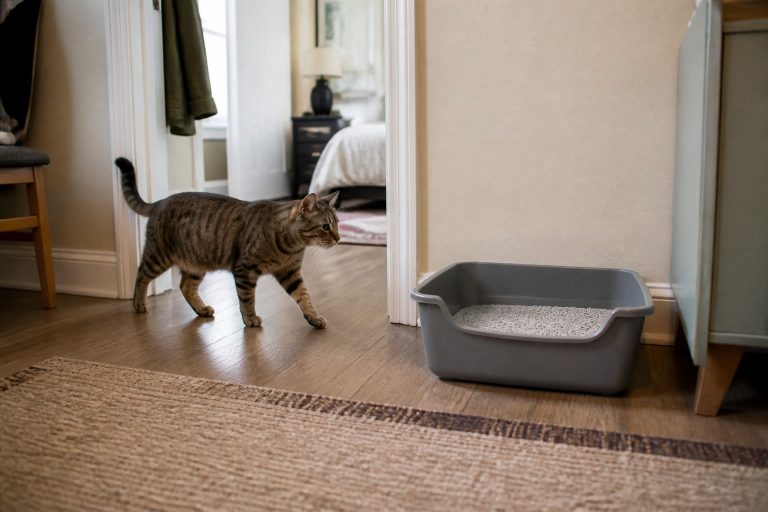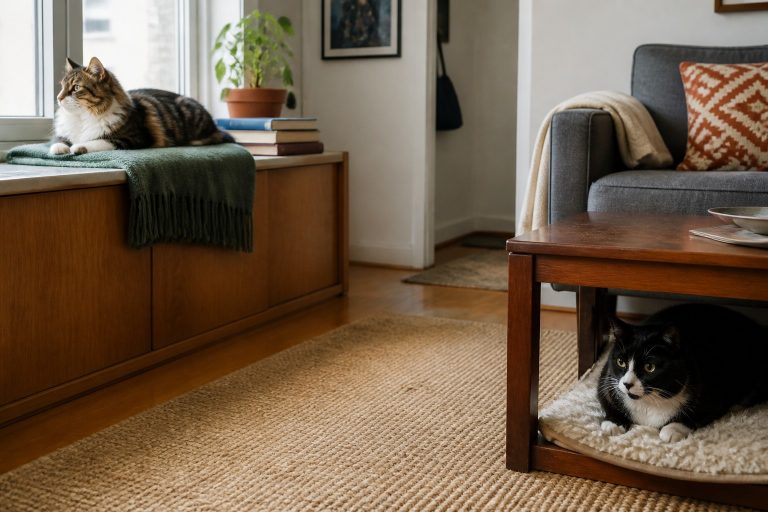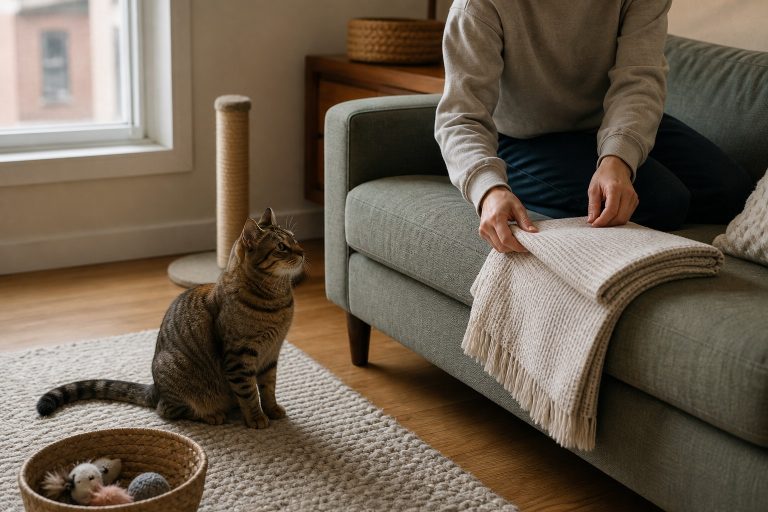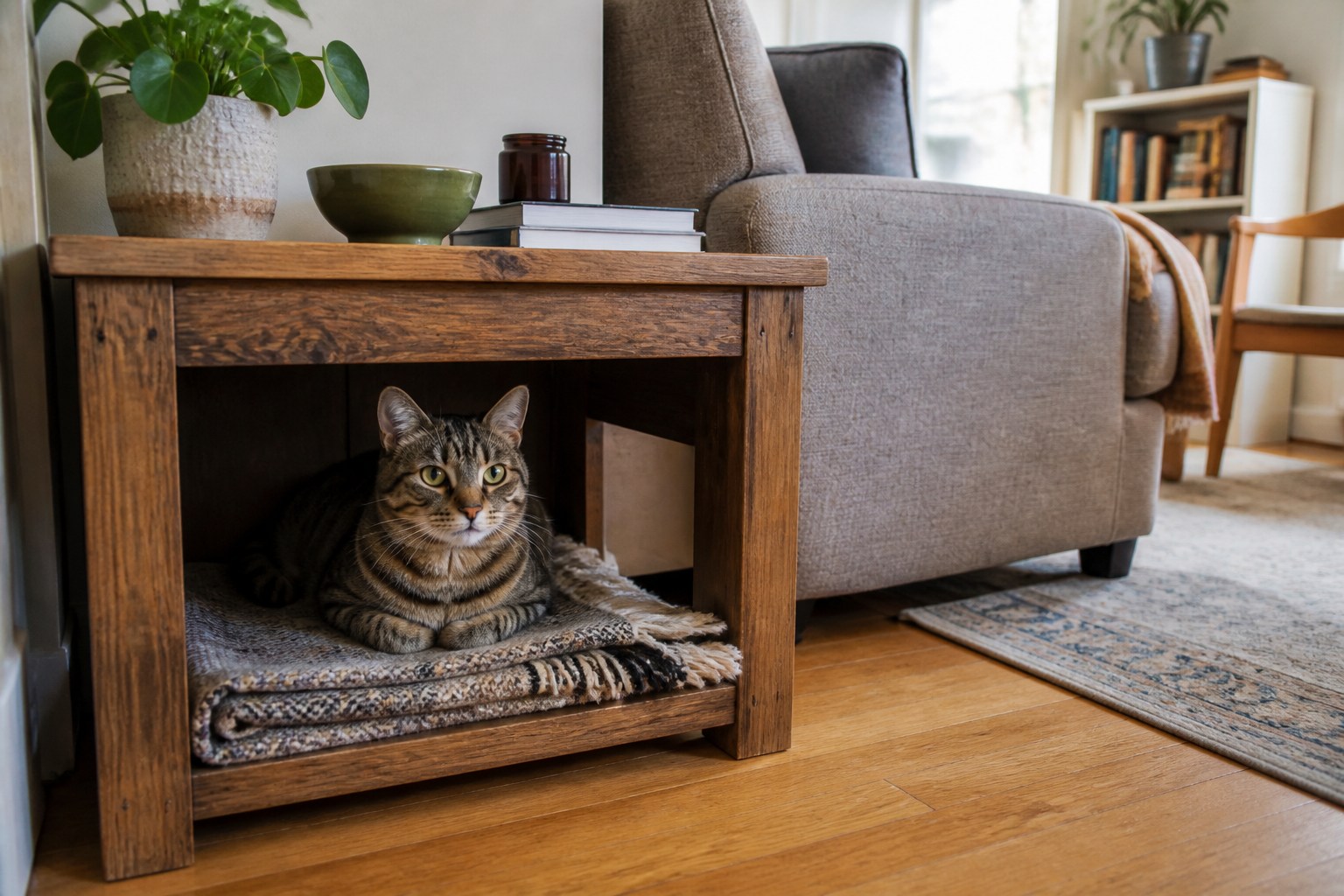

A cat slips under the end of a bench when the vacuum comes out, sleeps behind the arm of the sofa in the afternoon, and watches dinner from a half-screened shelf. None of those choices automatically signals a problem. A retreat can be a place to rest, observe, avoid traffic, or simply decide how much of the household to join.
The useful question is not whether the cat is hidden. It is whether the place works. Can the cat reach it without squeezing past a dog, child, or another cat? Does the surface stay still? Can the cat leave easily? Will someone shut a door, pull out a chair, or reach into the space five minutes later?
You can answer most of those questions without buying a cat cave. Start with the places your cat already uses, then improve privacy, access, comfort, and the household rules around them.
A Retreat Is a Choice, Not a Diagnosis
Professional feline environmental guidance treats access to a private, secure place as a basic part of a supportive environment. The AAFP/ISFM environmental-needs guidelines describe a safe place as an area that offers enclosure, isolation, or seclusion. It is often raised, but it does not have to be. A cat may feel less exposed even when part of the body remains visible.
That leaves room for different kinds of retreat: a low box with a side opening, a chair tucked behind a table, a broad shelf with partial visual cover, or the quiet end of a sofa. The function matters more than the label.
Research offers some support for the value of concealment, but the context matters. In a randomized study of newly admitted shelter cats, cats given hiding boxes showed a faster reduction in behavioral stress scores than cats without them. A shelter quarantine cage is not a living room, so the study does not prove that every household cat needs a box. It does support a narrower point: the option to withdraw from view can be meaningful, especially in an unfamiliar or demanding environment.
Normal use of a retreat is not something to correct. The household job is to make the option usable and voluntary.
Watch the Places Your Cat Already Chooses
Before changing a room, observe it at different times of day. A place that looks ignored at noon may be the cat’s preferred evening lookout. A bed that seems private may become unusable when someone starts working at the nearby desk.
Ask a few concrete questions:
- Where does the cat go when the room becomes busy?
- Does the cat choose full enclosure, an edge with partial cover, or height with a view?
- Is the location warm, cool, quiet, or close to familiar people?
- Does the cat leave when someone approaches?
- Is entry awkward or dependent on movable furniture?
- Can another animal wait at the entrance or control the route?
- Does the cat return consistently, or only when the household is arranged a certain way?
These observations are design feedback, not a diagnosis. They tell you which function the retreat is serving and what keeps interrupting it.
If the problem feels larger than one corner, the room-by-room cat-friendly home checklist can help map routes and resources across the home. N16’s narrower task is to improve the places where the cat steps out of the main flow.
Build for Concealment and Observation
A useful retreat does not need to block every sightline. Many cats choose places where the front remains open enough to monitor the room while the back and sides feel protected. A box turned sideways, the space between a chair and a wall, or a broad perch screened by the sofa arm can provide that balance.
Height can add distance from feet, dogs, or household activity, but it is one option rather than a ranking system. Some cats prefer a high observational position; others settle more readily in a low, enclosed nook. A cat may use both for different reasons.
Look beyond shape. A retreat also needs a surface where the cat can settle, enough room to turn or rest, and a temperature that remains tolerable. The sunny shelf that works in winter may become too hot in summer. The covered bed beside a radiator may be appealing in the morning and abandoned later. Leave another usable option rather than trying to make one place serve every condition.
The broader indoor-comfort guide covers temperature, windows, scratching, play, and routine. Here, those factors matter only when they change whether a retreat earns repeated use.
Use the Furniture You Already Have
Start by editing the room, not shopping for it. Clear one end of a stable bench. Move a chair slightly away from the busiest walking line. Place a washable, nonslip layer on a broad surface the cat already rests on. Leave a carrier open in an accessible area if the cat treats it as familiar furniture rather than a signal that a trip is coming.
A retreat can be visually quiet without being invisible to the household. Open space beneath a bed or cabinet may work if it is clean, stable, and large enough to inspect when necessary. A shelf can work if it is rated and secured for its normal use, wide enough for the cat, and not crowded with breakable objects. A blanket draped over part of a table can create temporary cover, provided it does not catch, collapse, or block ventilation.
Avoid improving privacy by creating an unsafe cavity. Do not encourage access behind appliances, inside reclining furniture, near moving mechanisms, in vents, or behind heavy pieces that could shift. Closet and cabinet retreats need particular care: the cat should not be trapped when a door closes, and the household must be able to check the space when there is a real reason to do so.
Specialized furniture can be useful when it solves a specific gap, but it is not the starting assumption. First improve access, stability, placement, and comfort in a location the cat has already endorsed.
Make the Route In—and Out—Dependable
A quiet nook is not useful if the approach changes every day. A dining chair may provide the only step to a shelf until someone pulls it to the table. A blanket may soften a cabinet top but slide during takeoff. A retreat behind a door may disappear whenever the door is fully opened.
Walk the route in both directions. Check the final step or jump, the landing surface, the room needed to turn, and the exit when the home is active. For an elevated retreat, the vertical-space guide goes deeper into destinations, stages, traction, and descent. The retreat question is simpler: can the cat arrive and leave without an unstable leap or a human rearranging the room?
In a multi-cat home, physical access is only part of the test. The 2024 AAFP intercat-tension guidelines describe how staring and blocking can prevent a cat from using a room or resource that appears available. Watch whether one cat waits at an entrance, controls the only descent, or makes the occupant pass at close range. A second opening, an alternate route, or a retreat in another part of the room may reduce that pressure. The broader distribution of multi-cat resources belongs in its own plan; here, the point is simply that a retreat should not become a trap.
Protect the Retreat From Household Traffic
Privacy depends on what people and other animals do after the retreat is created. Ohio State’s guidance on a household refuge emphasizes that a cat should be able to come and go freely and should not be bothered there.
That principle can become a simple household rule: when the cat is in this place, interaction is not imposed. Children can be shown where to pause instead of reaching in. A dog can be redirected from waiting beside the entrance. Vacuuming and cleaning can happen around the area without repeatedly dismantling it. Visitors do not need an introduction to the cat on demand.
The room does not have to be silent. A retreat beside the living room may work precisely because it offers distance without isolation. The important qualities are relative quiet, predictable access, and protection from repeated interruption.
Some retreats also need a time check. A home-office chair is calm until the workday starts. The space beneath a console is protected until bags are dropped there. Notice whether the retreat remains available during the hours when the cat actually seeks it, and move the household clutter or provide a second option before the favorite place disappears.
Run a Simple Retreat Check
Before calling a hiding place finished, test it against ordinary life. A useful retreat should be:
- accessible without squeezing through a hazardous or easily blocked gap;
- stable under the cat’s full weight and normal movement;
- protected enough to reduce unwanted attention;
- open to voluntary entry and exit;
- comfortable for the time and temperature in which it is used;
- placed where the cat has a reason to spend time;
- inspectable when health or safety genuinely requires it.
Then leave it alone long enough to become familiar. Do not repeatedly place the cat inside or lure the cat into a route you have not fully checked. Repeated use is the clearest sign that the location and setup make sense; abandonment is information that one part of the design may be wrong.
There is one important boundary. A cat that has always used quiet retreats may simply be following a normal routine. A sudden, persistent increase in hiding—especially alongside changes in appetite, movement, elimination, interaction, or another familiar behavior—deserves a call to a veterinarian. FelineVMA guidance on knowing what is normal for your cat emphasizes changes from the individual cat’s usual patterns rather than diagnosing from one behavior alone.
A good retreat does not remove the cat from the home. It gives the cat a workable way to participate at a chosen distance: hidden, partly visible, watching from above, or resting at the quiet edge of the room. Build that choice into the furniture and routines already present, and the home gains useful feline space without looking or functioning like a showroom of cat products.