
The home rarely becomes difficult all at once. A throw starts holding more fur than it used to. Toys collect beside the sofa. The hand brush migrates away from the place it is needed. A favorite window spot becomes drafty, while a bed in the warmest corner has flattened into a lumpy pad. Nothing is disastrous, but small bits of friction begin turning ordinary upkeep into a longer job.
That is a good moment for a seasonal reset. This is not a deep clean, a minimalist purge, or a reason to replace every cat item in the room. It is a short review of what the household is actually using now—and what will make the next stretch of weather easier to live with.
The broader goal of a clean cat-friendly home stays the same: contain predictable mess, protect the places that matter, and make routine care easy to repeat. The seasonal job is simply to recalibrate that system.
Start With a Walk-Through, Not a Cleaning List
Walk through the home at an ordinary time of day, before moving anything. Follow the route from the entry to the living room, feeding area, favorite resting places, and litter area. Notice what has changed since the last stretch of weather.
Perhaps shoes and bags have narrowed an entryway. A blanket that was comfortable near an open summer window now sits in a cool draft. The cat has started sleeping on a chair while an expensive bed goes unused. A toy basket blocks the easiest vacuum path. The litter mat has shifted just far enough that debris lands beside it.
Look for friction rather than trying to identify every imperfect surface:
- Where do fur, litter, crumbs, or dust keep escaping their usual boundary?
- Which task now requires carrying supplies from another room?
- What does the cat use every day, even if it is not the prettiest object?
- What has become dirty, worn, unstable, blocked, or genuinely unused?
- Which route will become busier when doors, windows, heating, or household schedules change?
This is a maintenance audit, not a complete welfare inspection. If the weak point is access between rooms, resource separation, or an unsafe landing, the room-by-room cat-friendly checklist takes that larger problem further. For this reset, choose the two or three places causing the most recurring work.
Use Keep, Clean, Repair, Move, Replace
Before throwing something away or shopping for an upgrade, give each problem item one of five decisions.
Keep it when it is safe, functional, and used. A scratched cardboard surface or slightly rumpled bed may look tired to a person while still doing exactly what the cat needs. Familiar is not the same as dirty, and visually minimal is not automatically easier for the animal living there.
Clean it when condition—not the calendar—calls for care. Wash a removable cover according to its label, vacuum the upholstered step the cat uses, or wipe the stable shelf that has collected dust. If an item cannot be cleaned safely, that becomes part of the next decision.
Repair it when a small fix restores safe use. Tighten accessible hardware on a perch, flatten a washable mat that has begun to curl, or mend a cover if the repair will not leave loose threads. Structural wobble, exposed staples, sharp edges, and damaged electrical parts are not cosmetic problems; stop access until the item is safely repaired or replaced.
Move it when placement creates the friction. Put the hand brush where litter actually lands. Return the scratcher to the route where the cat uses it. Move a blanket away from a draft, or clear the box that blocks a regular walking path. Change one placement at a time when possible so you can see whether it helped.
Replace it when the item is no longer safe, cleanable, stable, or useful. Replacement is a condition-based decision, not the required ending of every reset. A home does not become calmer by exchanging familiar objects for a new pile of unfamiliar ones.
Reset Textiles Without Erasing Every Familiar Place
Throws, bed covers, washable rugs, and the edges of upholstered furniture often hold the season most visibly. Work through them in layers instead of stripping every cat-used surface at once.
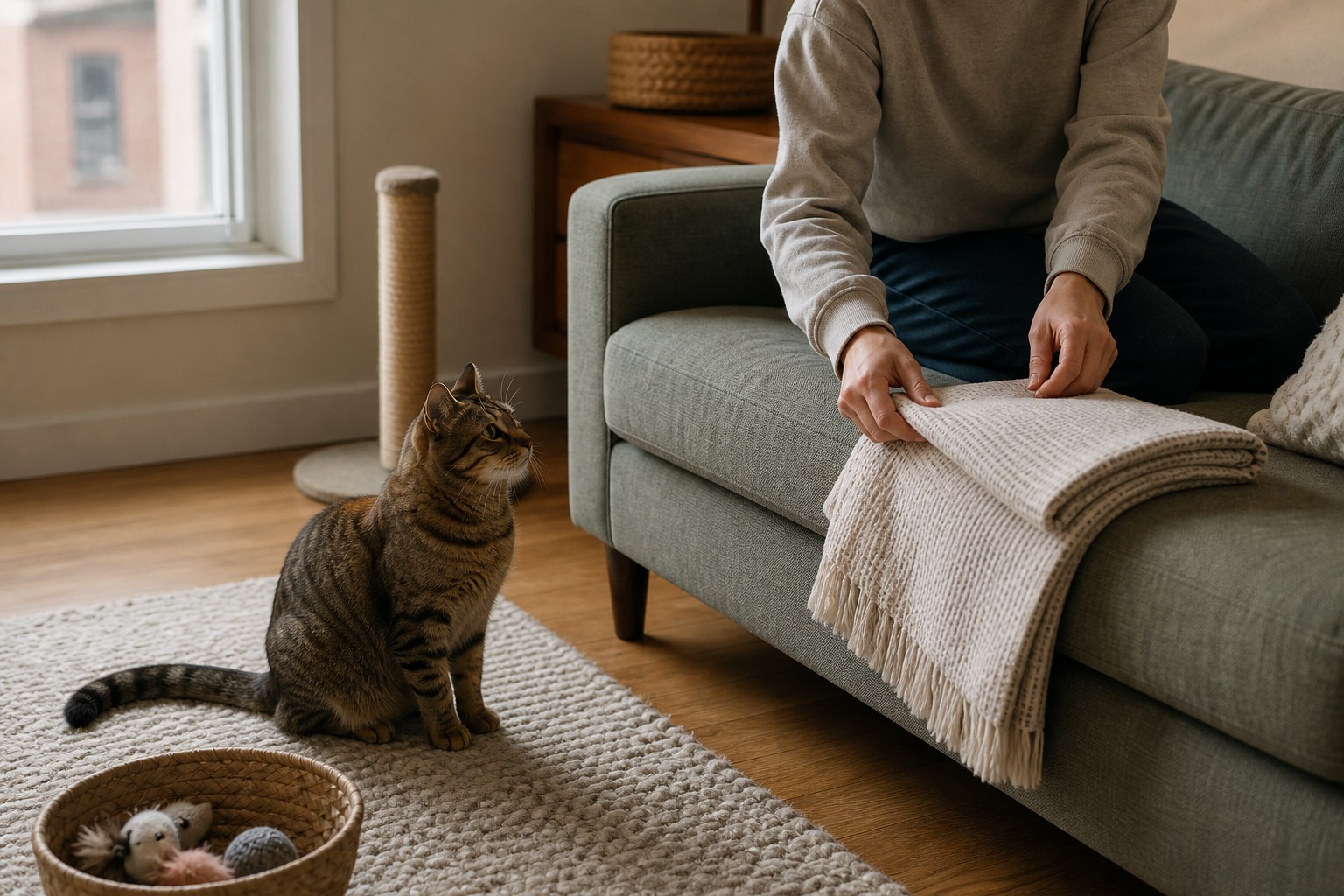
Start with what is soiled or due for care, following the fabric or product label. While one bed cover or throw is being washed, leave another familiar resting place available. The AAFP/ISFM environmental-needs guidelines describe the importance of familiar scent and recommend rotating bedding washes so some of the cat's scent remains. That does not mean leaving dirty fabric in place. It means hygiene and scent continuity can coexist.
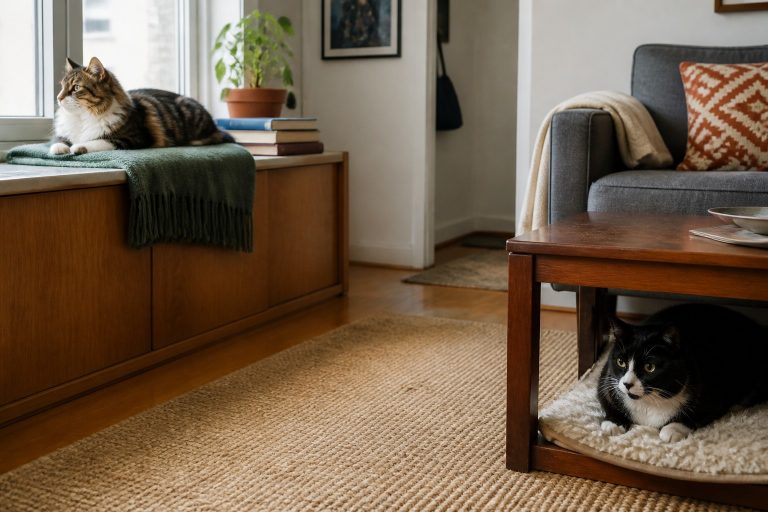
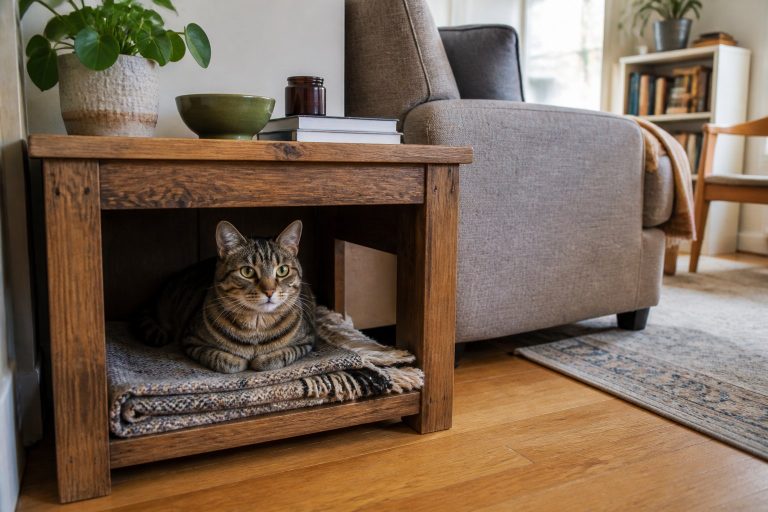
After washing, put useful layers back where they solve a real problem. A washable throw on the sofa may protect the surface the cat already chooses. A flat runner may catch debris in a high-traffic route. A bed may need a warmer or quieter position as sunlight and drafts change. Do not assume the location that worked three months ago is still the one the cat prefers.
Avoid treating fragrance as proof that the job is finished. A clean textile can smell neutral. The room does not need to announce a seasonal scent, especially when the cat's nose is much more involved in reading the space than ours.
Clear Shared Routes and Restore the Cat's Working Zones
Seasonal household items tend to arrive before older items leave: a fan stays beside the sofa when a blanket basket returns, or outdoor gear gathers near the door. Clear the routes people and cats actually use, then restore the useful resources along those routes.
Begin with obvious obstructions and unstable stacks. Put supervised string toys away where the cat cannot reach them alone. Check scratchers, steps, window landings, water stations, and resting places for wobble, blocked access, or wear that changes how they function. The aim is not an empty floor. It is a floor that can be walked and cleaned without removing the cat's choices.
For toys and enrichment objects, sort by condition and use rather than volume. Discard unsafe damaged pieces. Clean items that are designed to be cleaned. Put a few usable options where the cat can actually engage with them, and store supervised toys where a person can retrieve them easily. Detailed variation and play belong in the indoor enrichment routine; the seasonal reset only restores safe access and removes accumulated friction.
Check the household tools at the same time. A lint brush, cloth, waste bag, or small vacuum attachment is helpful only if it is close enough to the problem to be used. Move the tool before adding a new one.
Give the Litter Area a Proportionate Check
The litter area gets one focused pass, not the whole article.
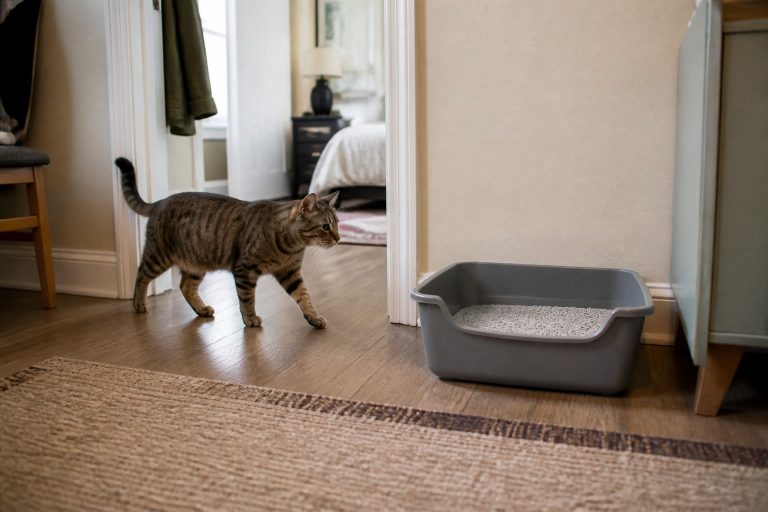
Scoop the box, then check the perimeter: mat, floor edge, scoop, waste container, nearby wall, and the route out of the area. Reposition a mat that has drifted, remove litter trapped underneath, and restock the supplies the household already uses. Confirm that a closing door, storage bin, or seasonal appliance has not narrowed access.
If the box or room still smells after ordinary source removal, do not answer the problem with fragrance or fold a full litter investigation into this reset. Use the litter-box odor guide to separate fresh waste, spent litter, box residue, concentrated use, and trapped room odor. A seasonal reset can reveal the problem; it does not need to duplicate the diagnosis.
Clean Without Adding Another Problem
Ordinary household cleaning does not require a special homemade formula. It does require using the product as directed for the surface and keeping the cat away from bottles, wet areas, buckets, and discarded wipes.
Read the label before use. Follow any directions for dilution, ventilation, rinsing, drying, or keeping pets away from the treated area. The EPA's pet-safety guidance makes the label the primary source for safe use and storage; the ASPCA likewise notes that many household cleaners can be used around cats when used according to labeled directions.
Do not combine cleaners or improvise a stronger mixture. The EPA specifically warns that bleach and ammonia can produce toxic chloramine gas. Keep the rule broader and easier to remember: use one appropriate product as directed, never a DIY combination.
Skip essential oils and strongly scented sprays as a “calming” finishing layer. Concentrated oils can be hazardous to cats depending on the oil, concentration, and route of exposure; the ASPCA's essential-oil guidance is more useful than a social-media recipe. If you are unsure whether a product is appropriate for a particular surface or household, ask the manufacturer or your veterinarian before using it.
This is a safety boundary, not a toxicology guide. If a cat may have contacted or ingested a cleaning product, use the product label's emergency information and contact a veterinarian or animal poison-control service rather than searching for a household antidote.
Leave the Next Season Easier to Maintain
A reset is complete when the recurring work has become smaller—not when every drawer has been reorganized.
Return familiar, functional resources before you finish. Put cleaning tools beside the zones they serve. Give seasonal objects a defined place so they do not reclaim a walking route. Then choose one or two maintenance changes that answer what you observed: shake out one throw on vacuum day, check the litter mat when scooping, or refill waste bags during the normal weekly cleaning routine.
Use this compact final check:
- The busiest routes are clear and stable.
- The cat still has familiar places to rest, scratch, watch, drink, eat, play, and toilet.
- Soiled textiles were cleaned without removing every familiar layer at once.
- Damaged items were repaired, removed from use, or replaced when necessary.
- Cleaning products are closed, stored, and used according to their labels.
- The two or three recurring friction points now have a simpler response.
Stop there. The point of the reset is not to make the home look untouched. It is to make the next ordinary week feel less crowded with small unfinished jobs—while the cat can still recognize and use the home that was reset.