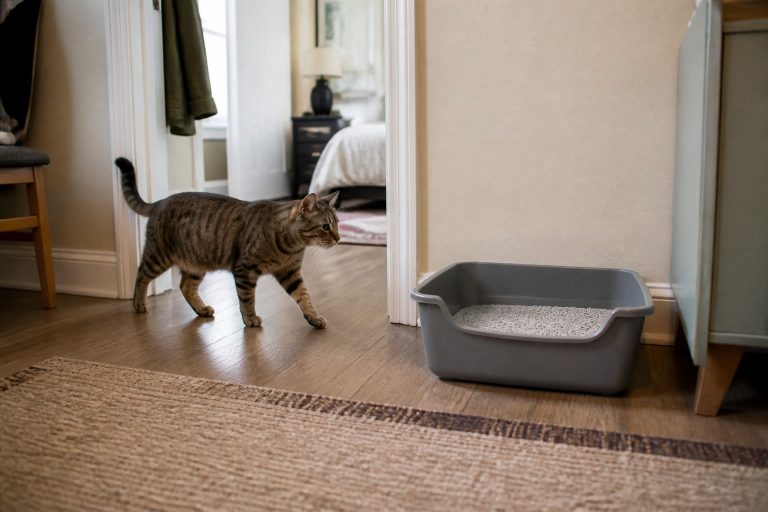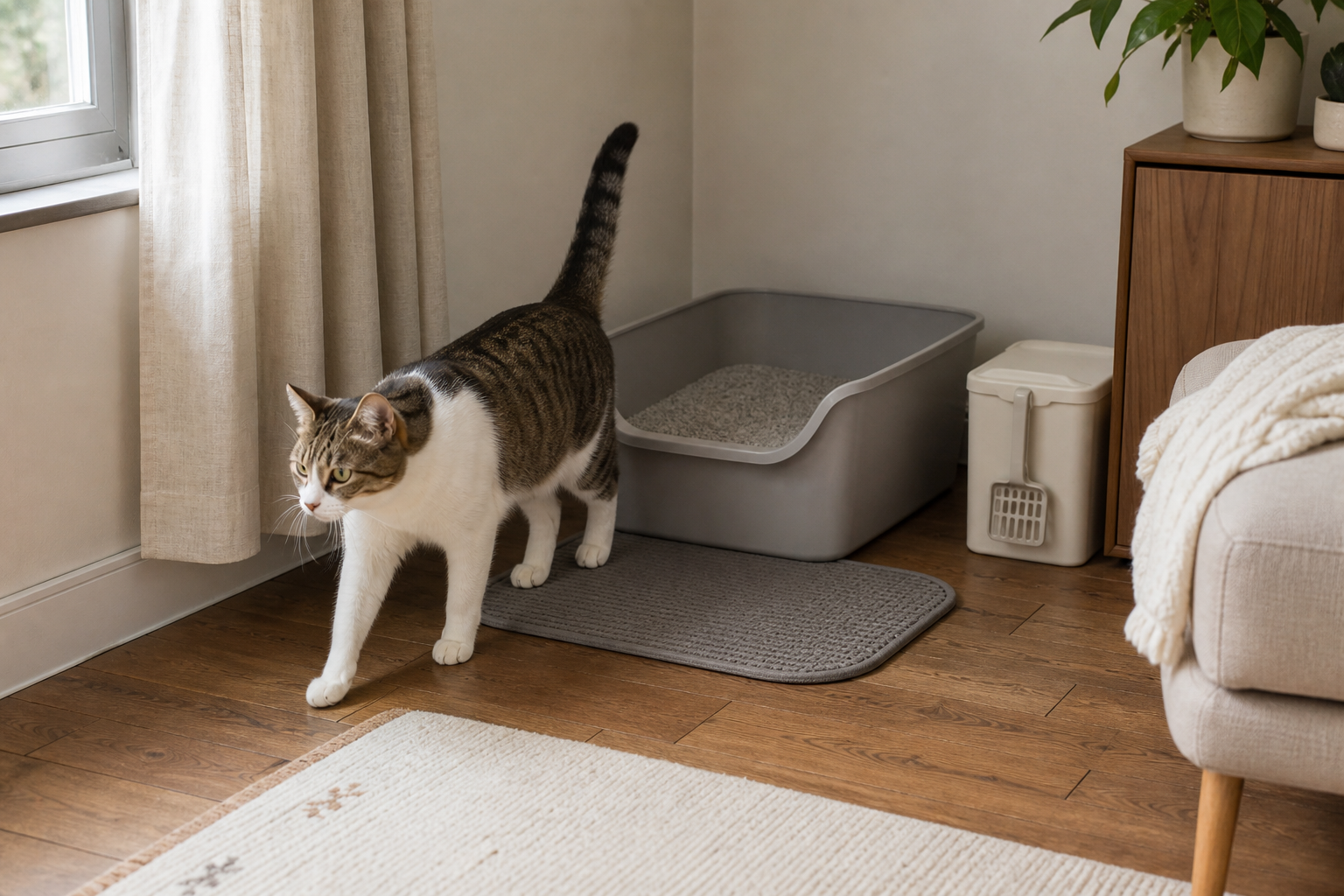

Most litter areas are planned backward: the box goes in the least visible corner, then the household tries to solve the scatter, odor, awkward scooping, or a cat that seems reluctant to use it. Those may look like separate problems, but they often meet in the same small area.
This guide will help you assess that area as a working setup—route, box, litter, surrounding floor, and upkeep—without turning it into a product project. The aim is a place the cat can use comfortably and the household can maintain without a daily struggle.
Map the Cat’s Route—and Your Own
Before buying accessories or rearranging furniture, trace two routes.
Follow the cat’s path to the box. It should remain available during the day and at night, including when doors close or the home gets busy. Look for narrow passages, sudden appliance noise, or a doorway where a dog, child, or another cat could interrupt the approach. In a multi-pet home, avoid a blind dead end that leaves the cat with no easy way out.
Then trace the cleaning path. Where will you stand to scoop? Can you reach the whole box, refill it, and lift it out without shifting a cabinet? Where will the waste go? A location that works only when the room is rearranged is unlikely to stay convenient.
Feline-care guidance supports a quiet, reliably accessible location and separation between toileting, food, and water. It does not establish one perfect room or a universal distance between resources. In an ordinary home, “quiet” is better understood as low-interruption, not remote.
A basement may be calm but impractical for a cat that struggles with stairs. A closet may look tidy but become inaccessible when the door closes. Walk the route during the household’s busiest hour, not only when the room is empty.
If choosing the room is still the sticking point, this guide can help you find a workable litter box location in a small home.
Give the Cat Usable Space, Not Just a Large Label
Judge the inside of the box rather than the size printed on the package. The cat should be able to step fully inside, turn, dig, position, and leave without balancing at the entrance or crowding the walls.
In one four-week household study, cats used the larger of two boxes more often. That finding supports paying attention to usable floor space; it does not establish a required dimension for every cat. Professional guidance also offers an approximate body-length rule, but the measuring language is not consistent across sources. A functional fit check is more useful here than a rigid shopping number.
Interior room can disappear inside a hood, liner, mechanical unit, or furniture enclosure even when the outside footprint looks generous. With an automatic litter box, compare the full machine footprint with the usable litter bed rather than assuming a wider shell means more turning room. Entry height matters too. A high wall may help contain scatter, yet it may be difficult for a kitten, senior cat, or cat with limited mobility. Recheck both the entrance and the interior as a kitten grows or a cat’s movement changes.
Open and covered boxes are another fit decision, not a universal verdict. A small 14-day study found no overall preference when 27 cats were offered large covered and uncovered boxes; a few cats preferred each style. The trial did not represent every household or typical compact hooded box.
For either style, check the room inside, the entrance, the view out, and how easily the box can be inspected and cleaned. If the cat hesitates or perches at the edge, treat that as a reason to reassess—not proof that one box category is always wrong.
Treat the Box and Litter as a Pair
Changing the litter changes how the box feels under the paws and how much work it creates around the home. Fine, unscented, clumping litter is a common starting point in feline guidance, but it is not a requirement for every cat.
When the current box is still being used, avoid replacing the box, litter, and location all at once. A gradual change or a side-by-side choice keeps a familiar option available and makes the cat’s response easier to interpret.
Material, texture, dust, disposal, odor, and tracking deserve their own decision. The guide to choosing cat litter compares those household tradeoffs without assuming one material is best.
Make Maintenance and Containment Work Together
Daily care should not require dismantling the area. Leave enough clearance to scoop and refill the box, and keep routine supplies safely nearby if that works for the home. Nearby storage is a practical convenience, not a research-backed rule; it still has to account for children, pets, and hygiene.
At least daily waste removal is the clearest point of agreement across feline guidelines and university veterinary guidance. A heavily used box may need attention sooner. Full litter replacement and washing do not have the same universal timetable: the litter system, number of users, condition of the box, and product instructions all affect the schedule.
A workable daily reset can be brief: scoop, restore litter as needed, and check the box and immediate floor. The deeper routine should follow actual use rather than a calendar invented for every box. From there, a simple weekly cleaning routine for cat owners can place litter-area care within the rest of the home.
If daily scooping is the part most likely to be postponed, an automatic litter box can make waste removal more regular. It does not remove the need to check litter level, empty the waste drawer, clean the surrounding floor, or periodically take the unit apart for deeper cleaning.
Containment should make that reset easier, not make the box harder to use. If you add a mat, higher wall, screen, or cabinet, check for a difficult threshold, reduced turning room, a guardable entrance, or surfaces that are awkward to clean. No mat or enclosure can be assumed to solve tracking or odor on its own.
A little litter near the box is not automatically a failed setup. Aim for a cleanable landing area that keeps routine scatter manageable without narrowing the cat’s path. Detailed tracking fixes, odor diagnosis, and deep-cleaning methods belong in their own guides.
In a Multi-Cat Home, Count Is Only the Start
“One box per cat plus one” is a common rule of thumb, not a guarantee. Current professional guidance on intercat tension also emphasizes separate locations, access on the levels cats use, social relationships, and the possibility of one cat blocking another.
Guidance treats adjacent boxes as one toileting station rather than truly separate resources. A box can also appear available on a floor plan while another cat watches the entrance or controls the hallway leading to it.
Use the count as an initial check, then look at what each cat can actually reach. Stations in different locations provide more meaningful choice than a tidy row in one corner. If cats do not comfortably share space, the layout may need to reflect that even when there is no obvious fighting.
Watch the Setup in Daily Life
A sensible floor plan still needs to work when the home is occupied. After assembling a basic setup, watch how it is used before adding concealment, automation, or several new variables.
If a defined check helps, keep notes for about a week. That is a household testing suggestion, not a research rule. Look for a few practical signals:
- Does the cat approach, enter, turn, and leave without repeated hesitation?
- Does another pet wait, stare, chase, or block the route?
- Is scatter staying within an area that is easy to clean?
- Does the box become unpleasant before the planned scoop?
- Is the person responsible for cleaning postponing the task because access is awkward?
Change one main variable at a time where practical. If the entrance seems difficult, address access before replacing the litter. If the route becomes noisy, test the location before adding a cover. This is a simple way to make the result easier to read, not a promise that every cat will respond in the same way.
Where Automation Can Actually Help
Once placement, access, litter choice, and usable space are working, automation can reduce one repetitive part of the routine. An automatic litter box removes clumps after use instead of waiting for the next manual scoop. That can be helpful for people with long workdays or in a frequently used multi-cat station, although it does not make additional stations unnecessary or guarantee that every cat will accept the machine.
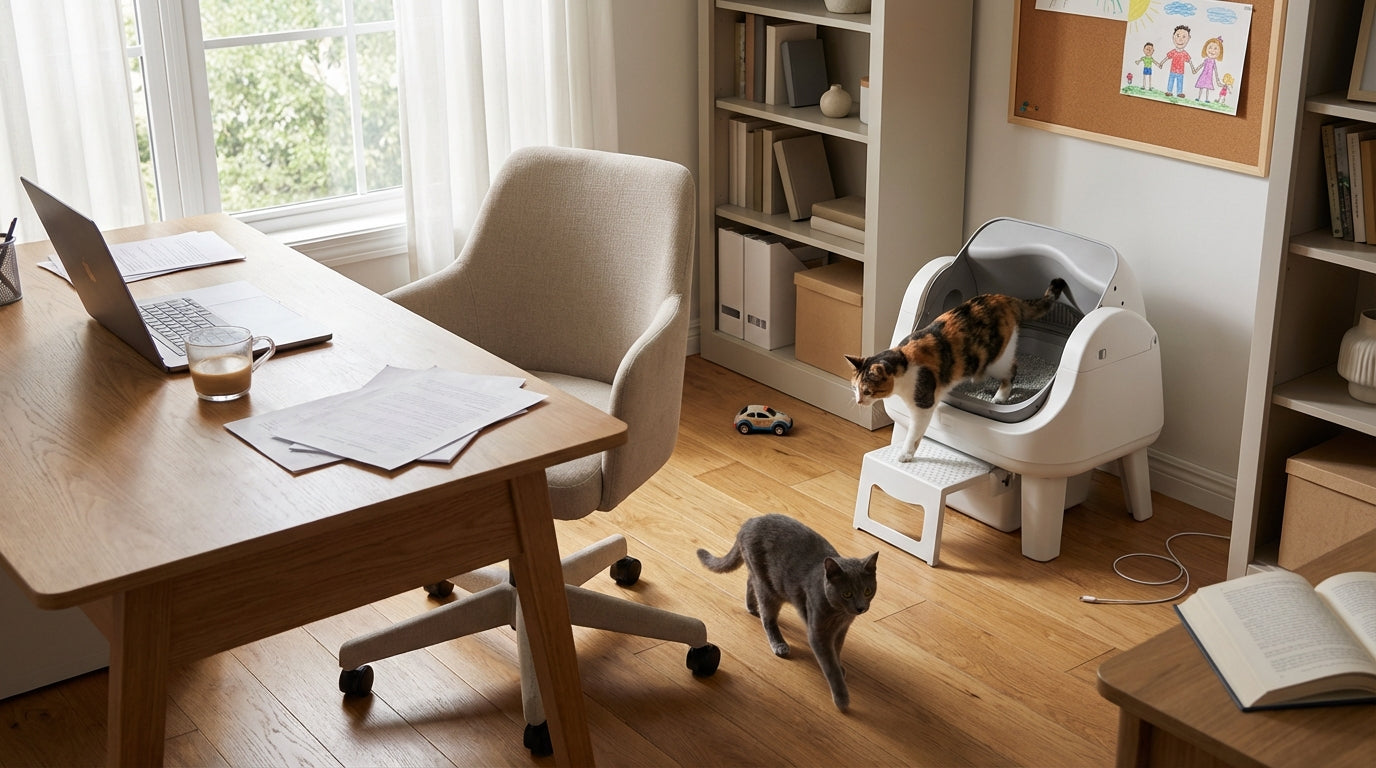
An automatic box is one possible change, not a shortcut around poor access or an awkward room. It cannot correct a blocked route, a cramped interior, an entrance the cat dislikes, incompatible litter, disruptive sound or motion, or a design that is difficult to wash. Before choosing one, check the overall footprint, usable interior space, entrance height, operating sound, litter compatibility, waste-drawer access, cleaning access, and transition instructions.
Plan the change as a transition rather than an instant replacement. Keep a familiar option available while the cat investigates, follow the manufacturer’s introduction steps, and watch normal use before relying on automatic cycles. Readers considering the change can review what to consider before buying an automatic litter box.
Know When the Room Is Not the Whole Problem
If litter box avoidance or house-soiling is new—or the cat is straining, in pain, making repeated attempts, producing unusual output, or showing another abrupt change—contact a veterinarian promptly. The Cornell Feline Health Center’s guidance on house soiling explains why medical causes should be ruled out. A more accessible setup may help with use, but it cannot diagnose or treat an underlying condition.
A litter area is working when the cat can reach and use it normally, mess stays manageable, and routine care does not require a burst of motivation. It may remain visible. It may be simple. What matters is that it keeps working after the room returns to ordinary life.