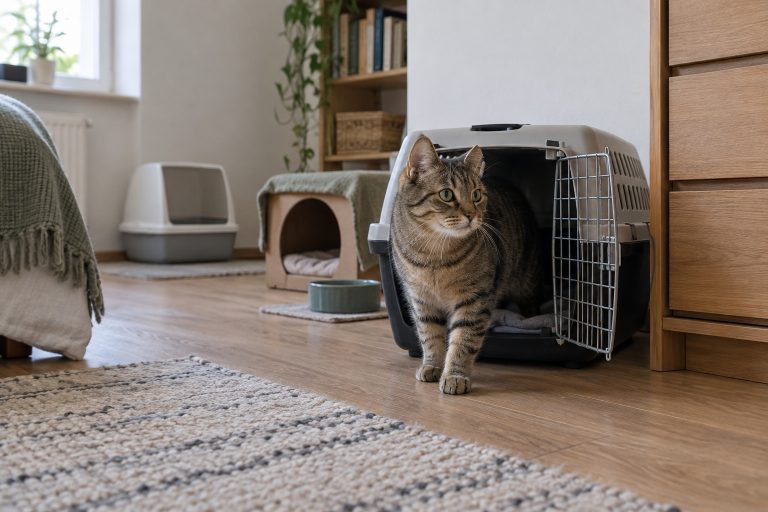

The toy basket is full. A few balls have rolled under the sofa, a wand sits behind a door, and something battery-powered has not moved in weeks. Yet the cat walks past all of it and waits by the window—or follows a person into the kitchen.
That does not necessarily mean the toys are wrong or the cat needs more of them. An object on the floor is not automatically an experience. What matters is whether it creates something the cat can actually do: stalk, chase, search, scratch, climb, watch, retreat, investigate, or choose a little contact.
Indoor enrichment works better as a rhythm than an inventory. The rhythm does not need to be elaborate or timed to the minute. It needs a few useful opportunities that return often enough to be familiar, change enough to stay workable, and fit the household well enough to continue on an ordinary Wednesday.
Think in Opportunities, Not Objects
Professional feline environmental guidance describes more than playthings. It includes safe places, separated resources, opportunities for play and predatory behavior, positive and predictable social interaction, and an environment that respects how cats use their senses.
That is a better starting point than counting toys. Ask what an item or part of the room allows the cat to do.
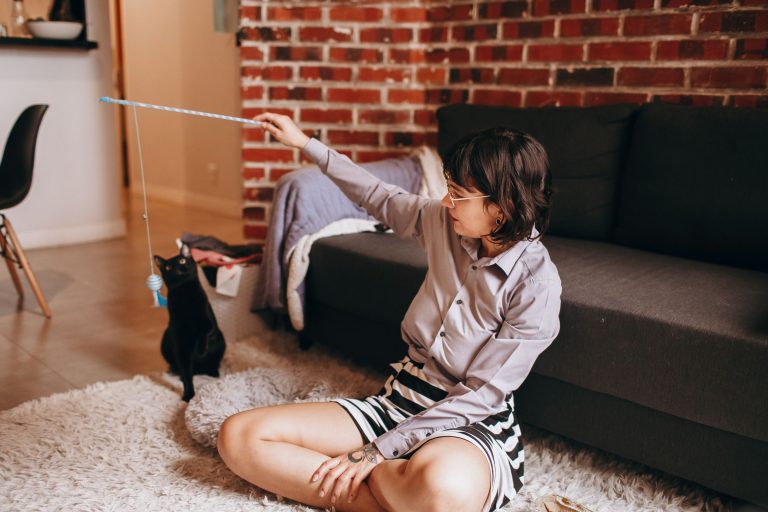
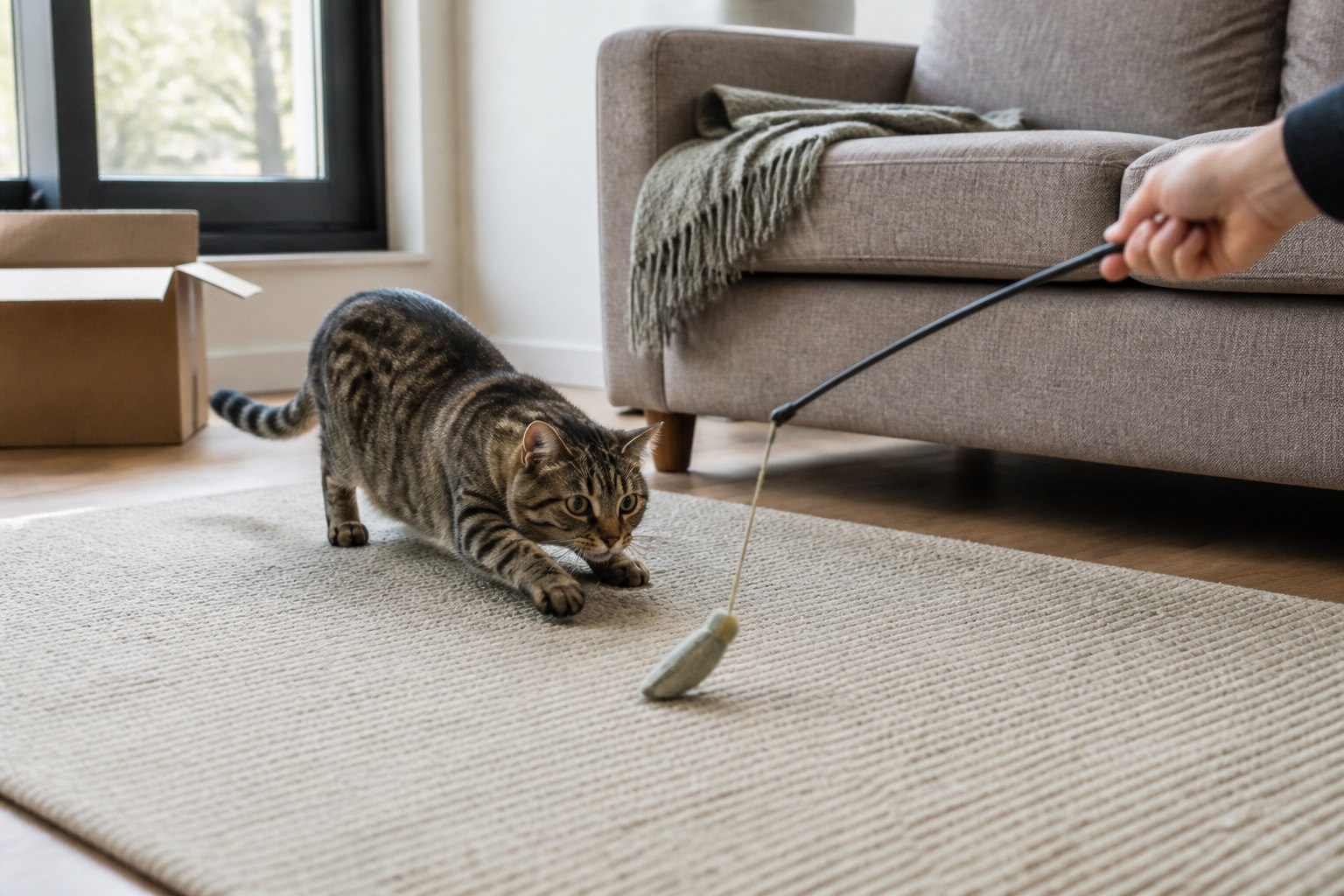
- A wand-style toy can create stalking, pursuit, and capture when someone moves it.
- A cardboard box can support hiding, ambushing, exploring, or sleeping.
- A scratcher can provide a place to stretch and leave scent and visual marks.
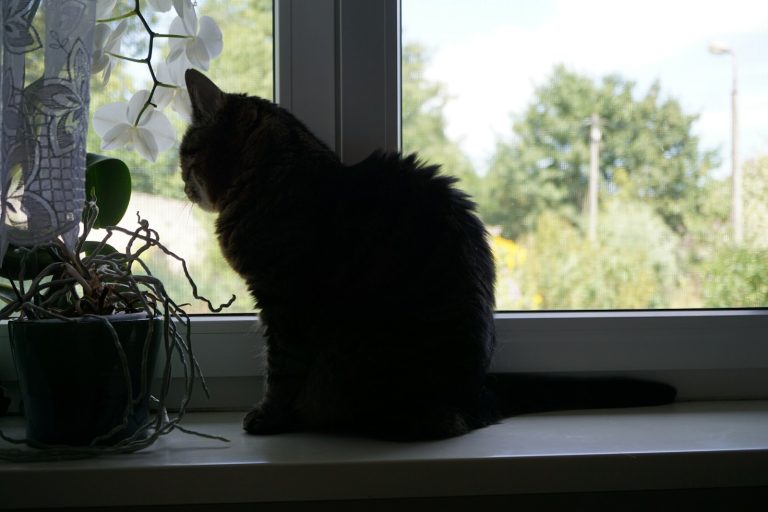
- A clear window landing can offer observation without adding anything new to the floor.
- A few pieces of the cat’s usual food can become a simple search instead of another snack.
The same object may be useful in one home and irrelevant in another. Placement, movement, access, and timing all matter. A toy wedged beside the vacuum cleaner is technically available but may not be inviting. A perch that another cat controls is not truly available. A puzzle that is too difficult on the first try is not much of an opportunity.
If the spatial foundation is not working, start with the room-by-room cat-friendly home checklist. Once the cat can use the home comfortably, the next question is what can happen there during the day.
Build Around Moments That Already Happen
A sustainable routine usually attaches to something the household already does. It does not add ten new chores.
Morning feeding can include a few pieces placed in easy-to-find locations while the rest stays in the usual dish. Opening the curtains can also mean clearing the cat’s window landing. A short pause after work can become interactive play. Tidying the living room can include putting one activity away and making another accessible. Evening wind-down can include quiet contact for a cat that seeks it—or simply leaving an undisturbed retreat for one that does not.
These are anchors, not a timetable. The useful pattern is “this opportunity tends to return,” not “play must begin at 6:15.” Predictability can make an activity easier to anticipate, while flexibility keeps the routine possible when the workday changes.
Choose one or two anchors you can maintain before adding more. If the routine depends on assembling equipment, moving furniture, and cleaning several parts every time, it is unlikely to last. Keep the toy where an adult can reach it but a cat cannot become tangled in it. Use a container that makes reset simple. Let ordinary furniture do more than one job when it is stable and safe.
The same restraint applies when deciding what to buy. The everyday cat essentials you actually need starts with the missing function, then asks whether the home already contains something that can provide it.
Use Interactive Play as a Conversation, Not a Quota
Interactive play is different from leaving an object on the floor because another participant controls movement and responds to the cat. Some cats watch for a while before moving. Some prefer ground-level motion that disappears around a corner. Others respond to brief movement through the air. The toy should move away from the cat more often than toward the cat, with pauses that make stalking possible.
AAFP/ISFM guidance recommends offering parts of predatory behavior and allowing the cat to catch the physical toy. Ohio State’s interactive-play guidance also advises keeping hands and feet out of the game. Together, those principles are more useful than a fixed number of minutes:
- Give the cat a chance to watch, approach, pursue, and catch.
- Let the toy pause instead of moving at maximum speed throughout.
- Keep strings and detachable parts supervised and put them away afterward.
- End when interest fades rather than repeatedly pushing the toy back into the cat’s space.
“Successful” play does not have to look dramatic. A senior cat may track a slow object from a rug and make two deliberate pounces. A timid cat may engage from the edge of a box. A kitten may need more frequent, energetic outlets. The opportunity should fit the cat’s body and confidence, not an online performance standard.
There is no well-supported universal duration or daily session count for every household cat. Repetition still matters, but the better measure is whether play appears often enough to be part of life and ends while it is still voluntary.
Let Some Food Involve Safe Effort
Food can support seeking and problem solving, but this does not require replacing every meal with a complicated device. It can be as simple as placing a few pieces of familiar dry food in visible, easy locations or using a shallow household-safe object that the cat can investigate without getting stuck.
A peer-reviewed review of food puzzles for cats describes potential welfare benefits while also noting that the evidence base was still developing. Its practical advice is suitably restrained: introduce a puzzle gradually, use familiar food, make the first version easy, and consider offering it beside the normal feeding option at first.
Difficulty should rise only if the cat continues to engage. If food becomes unreachable, the device slides frighteningly across the floor, or another cat takes over, simplify the setup. A rejected puzzle is information, not proof that the cat is lazy.
Use food from the normal daily allowance rather than quietly adding calories through “enrichment” treats. Cats with prescription diets, feeding restrictions, weight-management plans, or medical conditions need an approach that fits their veterinarian’s guidance. This article is about how food is obtained, not what or how much a cat should eat.
Let the Home Do Part of the Work
Not every enrichment opportunity needs a person present. A secure window, a stable chair back, a scratcher near a route, an open box, and more than one resting option can remain useful while the household is busy.
The question is still what the cat can do there. A window offers watching; a box offers concealment and investigation; a stable elevated surface offers a different view and route; a scratcher offers a normal physical and marking behavior. If a cat repeatedly scratches furniture, the detailed guide to redirecting scratching without punishment covers placement and surface fit without turning scratching into misbehavior.
In a small home, opportunities can overlap without becoming clutter. A cardboard box beside a sofa can be a retreat and a play edge, then be recycled when worn. A chair can provide a step and remain a chair. A storage bench can hold supervised toys and provide a window landing if its surface is secure. The small-space catification guide takes those spatial compromises further.
Some cats value height, but enrichment does not require a wall of shelves or a prescribed cat tree. Those decisions depend on the cat’s mobility, preferred routes, and the room itself.
Retreat is part of enrichment rather than the opposite of it. A cat should be able to stop participating, sleep without being handled, or watch from a distance. Activity loses its value when the cat cannot leave it.
Vary the Experience Without Constantly Buying Replacements
Variation can come from changing how an opportunity works, not from purchasing another object. Move a familiar toy differently. Bring a box into the room for a while. Shift a scratcher closer to the route the cat is using. Put one safe object away and bring it back later. Use a different room for a short search.
An experimental study of object play and habituation in adult cats found that play declined during repeated exposure to one object and renewed when a contrasting object appeared. That supports the general value of variation, but it does not produce a household rotation calendar. There is no evidence-based rule to swap toys every three days or every Sunday.
Change one variable at a time when possible: movement, location, difficulty, or availability. This makes it easier to see what helped. It also protects familiar options. Constant novelty can create work for the household without telling you much about the cat.
For objects left out, inspect them as part of the reset. Remove damaged pieces, loose strings, exposed stuffing, or parts small enough to swallow. A smaller safe collection that is easy to check is more useful than an overflowing bin no one can audit.
Watch What the Cat Chooses
Enrichment should offer control, not force participation. One preference study found substantial individual variation across human interaction, food, toys, and scent; in that sample, human social interaction was the most preferred category for many cats. That does not mean every cat wants more handling. It means an enrichment plan should not assume objects are the only reward—or that all cats want the same kind of contact.
When an activity is ignored, check:
- Timing: Was the cat resting, eating, or monitoring something else?
- Movement: Does the object rush toward the cat or move in an uninteresting way?
- Location: Is the area noisy, exposed, slippery, or easily blocked?
- Access: Can another cat take the resource or control the route?
- Difficulty: Is the food, landing, or object hard to reach?
- Preference: Does this cat repeatedly choose watching, searching, scratching, social contact, or another activity instead?
In a multi-cat home, use separate locations or separate turns when one cat consistently takes over. The 2024 AAFP intercat-tension guidelines emphasize dispersed resources and individual access; obvious fighting is not required for staring or doorway blocking to reduce another cat’s choices.
A simple weekly check is enough:
- Was there something safe to pursue or seek?
- Was there an appropriate place to scratch?
- Could the cat watch or explore from more than one position?
- Was there somewhere to retreat without being followed?
- Did the cat have some control over human interaction?
- Did at least one familiar opportunity vary in movement, location, or difficulty?
You do not need to answer yes to every line every day. Look at the pattern, then adjust the easiest weak point. If activity, mobility, appetite, withdrawal, or willingness to play changes markedly or suddenly, do not treat it as an enrichment failure. Cornell’s guidance on a cat that is slowing down is a useful reminder that reduced movement can reflect pain or illness and deserves veterinary attention.
The goal is not a busier home. It is a home where meaningful opportunities recur without becoming another demanding household system—and where the cat can use them, ignore them, and show you what should happen next.