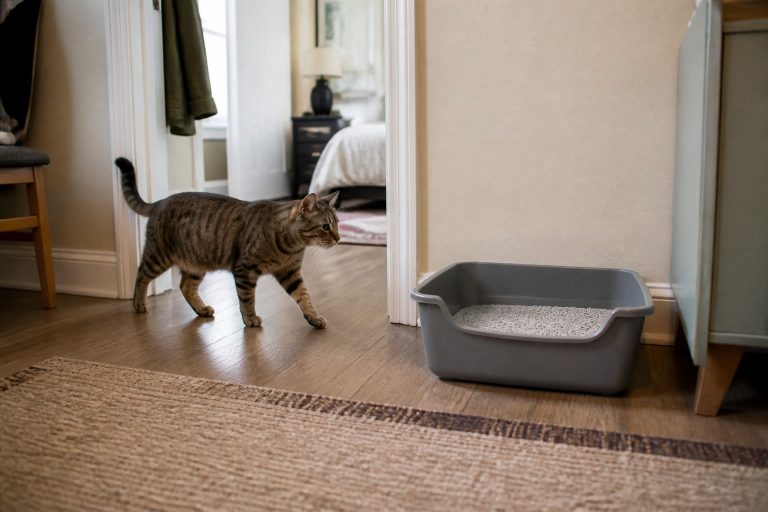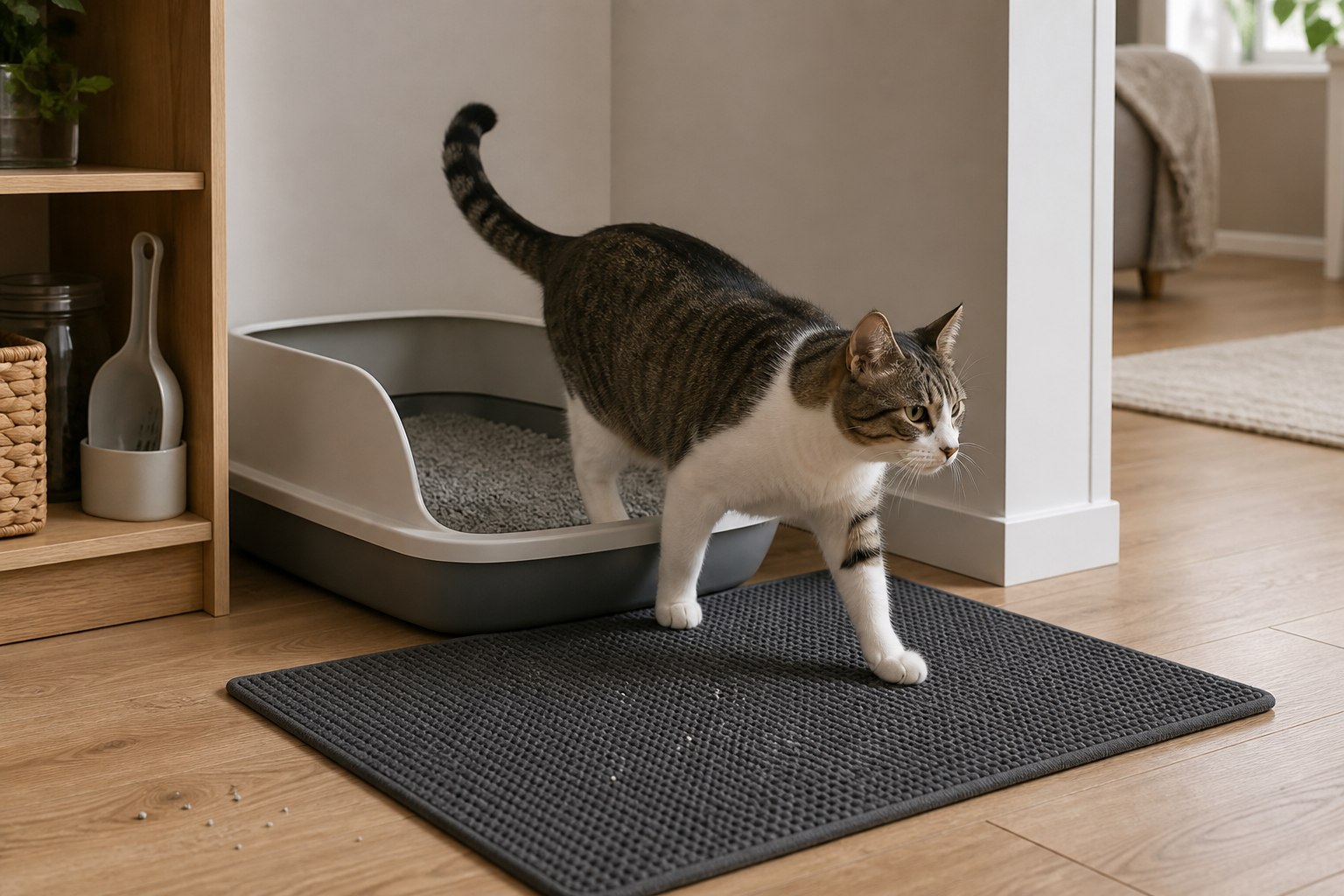

Litter tracking often gets treated as one problem: there is litter on the floor, so the setup must need more containment. But the same mess can arrive by different routes. A cat may throw litter over a low edge while digging. Loose grains may ride out between the paws or in fur. The box may be doing a reasonable job while the first landing surface catches almost nothing. By the time litter reaches the hallway, those causes look alike.
The useful question is not “How do I trap every grain?” It is “Where is the litter leaving the system?” Start at the box and work outward. Reduce direct scatter at the edge, check what the litter itself does, create an easy transition onto the floor, and let routine cleaning handle what remains.
That order matters because some of the most aggressive tracking fixes—a tall entrance, a top-entry box, a tight cabinet, a rough mat, a forced exit route—also make the box harder to use. A cleaner floor is worthwhile. Easy access is not negotiable.
First, Watch How the Litter Leaves
Clear the immediate floor, then watch one or two ordinary box visits if your cat is comfortable with that. You are looking for two broad patterns.
Direct scatter happens during digging, covering, or a quick exit. You may see grains cross the wall of the box and land in a concentrated fan beside it. Digging and covering are normal parts of feline elimination behavior; the goal is to contain some of the movement, not stop the cat from digging.
Carry-out appears after the paws reach the floor. A few grains fall on the first steps, or continue farther into the room. Litter may be resting between the toes, clinging to fur, or simply sitting loose on the paws after the cat pushed off.
The distinction does not need to be perfect. If most of the litter lands beside one wall, work on the edge first. If the box stays tidy but a trail follows the cat, look at litter and the transition surface. If both happen, start with the larger source instead of changing everything at once.
Reduce Direct Scatter Without Raising the Entrance
For a cat that sends litter over the back or sides, higher walls can be a sensible adjustment. Ohio State’s feline guidance specifically notes that high sides or a rim may suit cats that scatter litter while digging. The same guidance—and Cornell’s advice for older cats—also supports low entry points for kittens and cats that have difficulty climbing in and out.
Those needs can coexist. A box with a low cut-out at the entrance and higher walls elsewhere contains the likely scatter zone without turning every visit into a high step. The entrance still needs to be wide and obvious, and the interior needs enough room for the cat to enter fully, turn, dig, position, and leave. A tall box that crowds the cat is not a containment improvement.
Check the litter bed before replacing the box. Feline guidance commonly recommends enough litter for normal digging—often around 1.25 to 2 inches—but also acknowledges individual preference and different litter systems. That is not evidence for one tracking-perfect depth. Do not make the bed uncomfortably shallow just to protect the floor. Instead, level large mounds away from the rim and notice whether the current depth lets normal digging send loose material straight over a low wall.
If box fit, entrance, and surrounding clearance are all in question, return to the broader litter-area setup guide rather than solving the whole system inside a tracking fix.
Treat Carry-Out as a Litter Tradeoff
Litter is not one uniform material. Particle size, weight, shape, dust, and what happens when grains become damp can all affect how easily material leaves the box. A U.S. Geological Survey technical review identifies bulk density, granule size, shape, and dust formation as relevant litter properties; it also notes that litter can be light enough to kick out and that grains adhering to paws contribute to tracking.
That supports observation, not a universal shopping rule. Larger or heavier particles may be less easy to carry in some setups, but coarse or hard pellets can feel very different underfoot. Professional feline guidance commonly uses fine, sand-like litter as a starting preference, and a recent litter-choice study also found meaningful preferences among the specific materials it tested. Cleaner floors do not make an unwanted substrate a good choice.
If the trail begins with grains falling from the paws, compare the current litter with one plausible alternative while keeping the familiar option available. Avoid changing the box, litter, mat, and location on the same day. A side-by-side or gradual trial makes the cat’s response easier to read and gives you a way back if use changes.
Labels such as “low tracking” do not settle the tradeoff. Look at what reaches your own floor, whether the cat still digs and covers normally, and whether the new material clumps or breaks down in a way your routine can manage. The guide to choosing cat litter covers the wider material decision; here, tracking is only one part of it.
If grains are visibly caught in long foot fur, note the pattern rather than turning this into a home-grooming project. Direct evidence comparing tracking by coat type is weak, and trimming around paw pads is outside the job of a litter-area guide.
Build a Comfortable Transition Zone
A litter mat works after material has already escaped. It may catch loose grains from the first few steps; it cannot keep a cat from throwing litter over the opposite wall or make an unsuitable litter easier to use.
There is little independent research establishing a best mat material, texture, or dimension. Treat a mat as a household test. It should lie flat, resist sliding, feel ordinary enough to walk across, and be easy to lift and clean. Place it where the cat actually lands, not where a product photograph says the exit should be.
Surface area matters in a practical sense: a small mat that ends before the first full step has little opportunity to catch anything. More mat is not automatically better. A deep, sharp, unstable, or strongly textured surface may be stepped around or jumped over. If that happens, the cat is showing you that the proposed transition is not functioning as part of the route.
Sometimes the better transition zone is simply a wider patch of easy-clean floor. That can be more useful than stacking mats, blocking side exits, or building a corridor that forces the cat to take extra steps. If the cat exits in several directions, improve source containment first and accept a modest cleanable perimeter around the box.
Also check what the mat collects besides dry litter. Urine at the entrance or under a box can turn a litter-catching surface into a harder-to-clean source of residue. A mat should simplify the reset, not hide what needs attention.
Do Not Turn Containment Into an Obstacle
Covered boxes, top-entry boxes, furniture enclosures, and narrow doorways can limit where litter flies. They also change the amount of interior room, the entrance, the view out, and the effort required to leave.
A small 14-day study comparing large covered and uncovered boxes found no overall group preference, while a few cats preferred each style. It did not establish that covers are a universal tracking solution, and it does not tell us how a cat will respond to a compact hood or cabinet. A cover decision needs a broader comparison than tracking alone can supply.
Top entry deserves even more caution. Independent evidence for a broad tracking benefit is thin, while the access tradeoff is obvious: the cat must climb in and jump or step out. It may work for an agile cat that readily chooses it, but it is not the default answer for a kitten, an older cat, a large cat in a tight box, or any cat that hesitates with elevation.
The same filter applies to DIY containment. Do not force the cat through a maze, around furniture, across several unpleasant mats, or into a single guardable exit. If a tracking fix produces hesitation, edge-balancing, jumping over the entrance, or a change in elimination behavior, remove the new obstacle and reassess. New difficulty entering or leaving the box, especially with another behavior or mobility change, warrants a veterinary discussion rather than a more restrictive design.
Let Routine Handle What Still Escapes
Some residual litter is a maintenance problem, not proof that the setup failed. Cats dig. Granular material moves. Floors and paws differ. The reasonable goal is a smaller, more predictable cleanup zone—not a promise that no grain will ever leave it.
Once direct scatter, carry-out, and the first landing are reasonably managed, keep the remaining reset small. A compact broom or the vacuum already used in the home can clear the perimeter. A stable mat can be emptied and cleaned before it becomes another source of loose litter. Smooth flooring immediately around the box is usually easier to reset than a deep rug, but changing the room’s flooring is rarely the first intervention.
Fold that work into the household’s existing rhythm. The simple weekly cleaning routine for cat owners is the better place for a broader floor-and-surface plan. N03 only needs the boundary: if access is good and the remaining litter stays near the box, routine cleanup may be the least disruptive fix.
Troubleshoot One Layer at a Time
Use this order when the source is unclear:
- Clear the floor and watch whether litter is thrown over an edge or carried out on paws.
- If it is direct scatter, identify the wall or opening it crosses before changing the whole box.
- Keep an easy entrance; add height only where it contains scatter without reducing usable room.
- If litter rides out, test one litter variable while preserving a familiar option.
- Put one stable, comfortable transition surface across the cat’s real exit path.
- Remove any mat, cover, doorway, or route that makes the cat hesitate or jump around it.
- Let a brief sweep or vacuum handle the small perimeter that remains.
Pause after each meaningful change long enough to see the next few normal uses. That observation period is a household method, not a fixed research schedule. Stop escalating when the cat uses the box comfortably and the mess is contained to an easy reset. Perfect containment is not worth turning a familiar toilet into an obstacle course.